
You found the car.
You checked the market value.
You compared listings.
You avoided overpriced dealers.
Now comes the part where most men lose money.
Negotiation.
This is where you either save $2,000. Or hand it over without realizing it.
In Part 1, we covered where to find cheap used cars in the U.S. Now we focus on how to control the final price.
Because the real deal is not found online.
It is made at the table.
Step 1. Always Get a Pre-Purchase Inspection
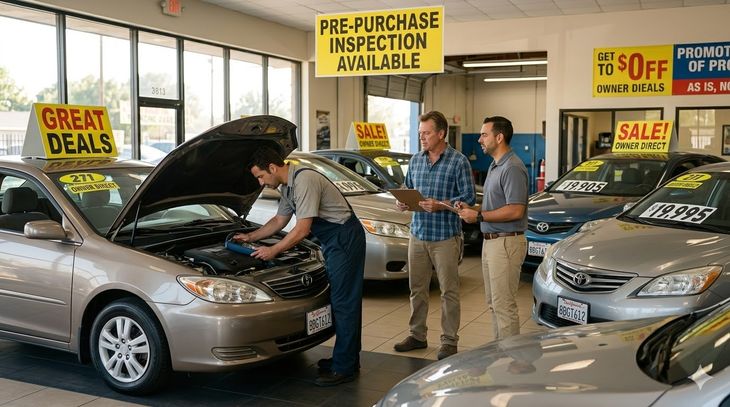
If you skip this, you lose leverage.
A pre-purchase inspection usually costs $100 to $200. That small investment can uncover:
- Worn brake pads
- Oil leaks
- Suspension issues
- Transmission problems
- Frame damage
If a mechanic finds $1,200 worth of needed repairs, you now have proof.
Not opinion.
Not emotion.
Proof.
You can say:
“The mechanic found brake wear and a minor oil leak. That will cost around $1,000 to fix. I can offer $1,000 less.”
This shifts the conversation from price to facts.
If the seller refuses inspection, walk away.
Serious sellers agree. Scammers do not.
Step 2. Understand the Power of Anchoring
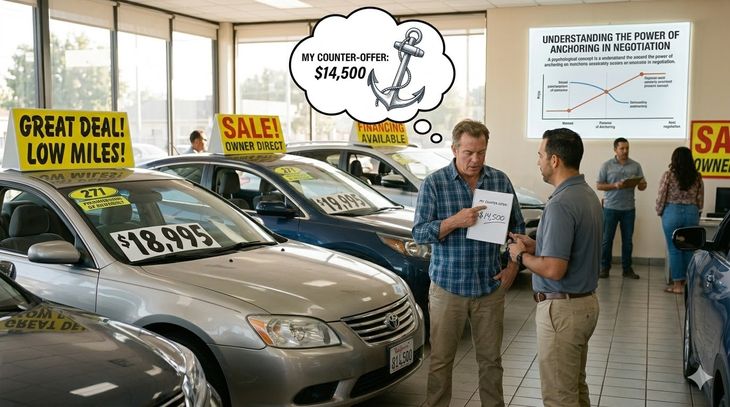
Anchoring is simple psychology.
The first number mentioned shapes the entire negotiation.
If the car is listed at $15,000 and you say:
“Would you take $14,500?”
You just anchored high.
Instead, anchor lower. Respectfully.
Example:
If market value is $14,200 and the listing is $15,000, start at $13,000 or $13,200.
Why?
It gives you room to move up while staying below your target.
Most sellers expect negotiation. Build it into your strategy.
Step 3. Use Silence as a Weapon
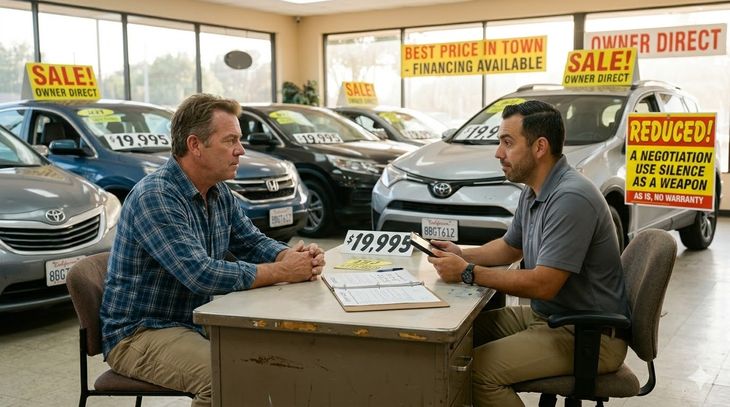
This feels uncomfortable. That is why it works.
After you make an offer, stop talking.
Do not explain.
Do not justify.
Do not fill the silence.
Let the seller respond.
Salespeople are trained to handle objections. They are not comfortable with silence.
Many will lower the price just to keep momentum.
Silence shows confidence.
Confidence wins deals.
Step 4. Be Ready to Walk Away
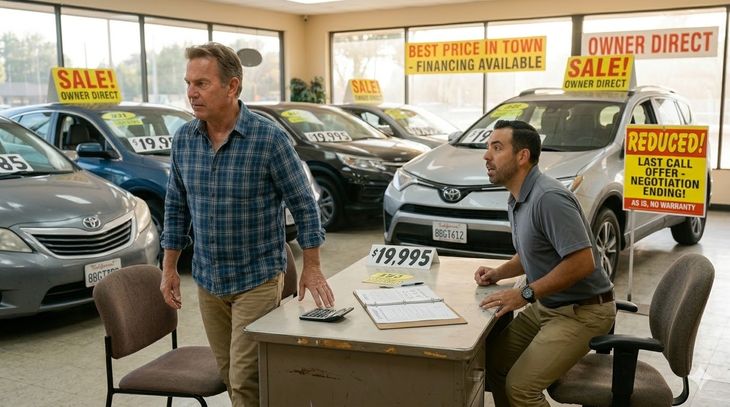
This is your strongest move.
If you are emotionally attached, you lose leverage.
There are thousands of used cars in the U.S. Right now. Listed today.
If the seller refuses a fair price, say:
“I understand. I appreciate your time. If you change your mind, here is my number.”
Then leave.
Many sellers call back within 24 to 48 hours.
Why?
Because serious buyers are rare.
When you walk away calmly, you show strength.
Dealer Tactics You Must Recognize
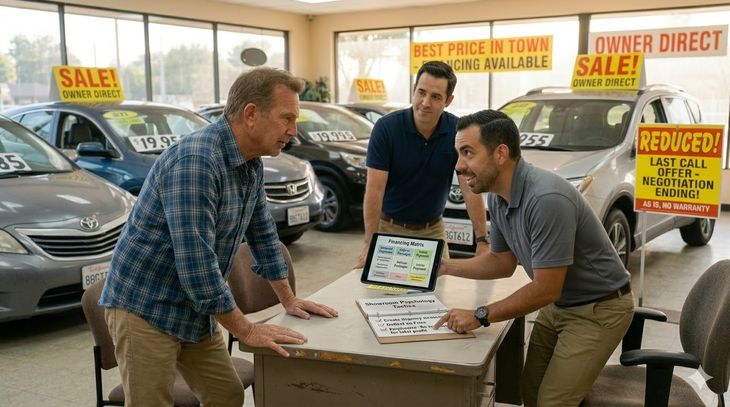
Dealerships are skilled. They do this daily.
You buy a car every few years.
Here are common tactics to watch for.
1. The Monthly Payment Trap
They ask:
“What monthly payment are you looking for?”
This shifts focus away from total price.
A dealer can extend the loan to 72 or 84 months. Your payment looks smaller. But you pay thousands more in interest.
Always negotiate total vehicle price first.
Then discuss financing.
2. Add-Ons You Do Not Need
Common add-ons include:
- Extended warranties
- Paint protection
- VIN etching
- Fabric protection
- Nitrogen-filled tires
Some add value. Many do not.
These extras can add $1,000 to $3,000 to your final price.
Ask for an itemized breakdown.
Remove what you do not want.
3. Documentation Fees
Doc fees are common. But they vary by state.
Some dealers charge $100. Others charge $800 or more.
You may not eliminate the fee. But you can negotiate the car price down to offset it.
Focus on the out-the-door price.
That is the number that matters.
Private Seller Negotiation Strategy
Negotiating with a private seller is different.
There is no sales manager. No finance office.
It is personal.
Here is what works:
- Build light rapport
- Ask about the car’s history
- Show you did your research
Then present your offer clearly.
Example:
“Based on similar listings and the inspection results, I can do $12,800 today.”
Notice the phrase “today.”
Cash in hand increases urgency.
Private sellers often value speed over squeezing every dollar.
Financing vs Paying Cash
Many believe cash always wins.
Not always.
At dealerships, financing can sometimes give them profit through lender partnerships. That means they may be flexible on vehicle price if you finance.
However:
Always compare loan rates through your bank or credit union before visiting the dealer.
A strong credit score gives you leverage.
If you pay cash to a private seller, that simplicity can help close faster.
The key is not the method.
The key is preparation.
How to Lower Taxes and Fees Legally
You cannot avoid taxes. But you can reduce unnecessary costs.
- Compare dealer fees across multiple locations
- Avoid unnecessary add-ons
- Consider private party purchases if your state taxes them differently
- Negotiate trade-in separately from purchase price
If you trade in a vehicle, negotiate your new car price first.
Then discuss trade-in value.
Never mix the two at the start.
Dealers use confusion to protect their margins.
Keep it clean. One number at a time.
The Final Checklist Before You Sign
Before money changes hands, check this:
- Title is clean and matches VIN
- No active liens on the vehicle
- VIN on dashboard matches paperwork
- No warning lights on the dash
- Test drive includes highway speeds
- Insurance quote confirmed
- Out-the-door price clearly written
Do not rush.
Pressure is a tactic.
Take your time.
The Real Formula to Get a Cheap Used Car in America
Let’s simplify everything.
Step 1. Find undervalued listings.
Step 2. Verify market price with real data.
Step 3. Get an inspection.
Step 4. Anchor low.
Step 5. Stay silent.
Step 6. Be ready to walk away.
That is how smart buyers save $1,000 to $3,000. Sometimes more.
Buying a used car is not about luck.
It is about discipline.
Most men overpay because they rush.
You will not.
You now know where to find deals.
You know how to negotiate.
You know the traps.
The next time you buy a used car in the U.S., you will not guess.
You will control the process.
And when you drive away, you will know one thing.
You did not just buy a car.
You won the deal.