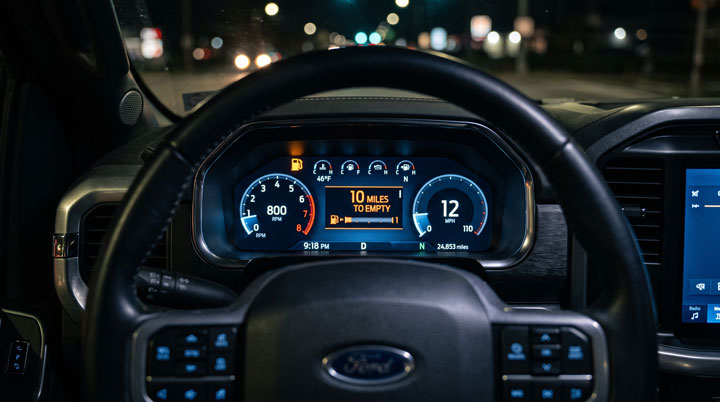
I still remember pulling into a remote highway gas station on a freezing evening with my truck warning me I had barely ten miles left to empty.
Squeezing thirty-two gallons into a tank I assumed held twenty-six left me completely baffled about my truck’s true capacity.
After years of diagnosing fuel sending units and helping fellow drivers in the shop, Team Bryan’s Garage created this ultimate ford f150 fuel tank size guide to give you exact capacities, true driving ranges, and actionable maintenance advice.
In This Article
- Standard 23-Gallon vs. Extended-Range 36-Gallon F-150 Fuel Tanks: Comparing Capacities, Range, and Costs
- Decoding F-150 Fuel Capacities Across Trims, Engines, and Model Years
- The Science of Distance-to-Empty Mechanics and the 5-Gallon Fuel Reserve
- Diagnosing Fuel Tank Recalls, Rusted Straps, and EVAP Vapor Leaks
- How to Measure Actual Fuel Capacity and Recalibrate Distance-to-Empty
- Common DIY Maintenance Pitfalls and How to Protect Your F-150 Fuel System
Your F-150 has a secret slot that starts the truck when your key fob dies.
And 8 other things Ford never told you.
Dead fob fix · Remote window trick · 7.2 kW generator hiding in your bed · Tailgate ladder · and 5 more.
▶ Read Now — Show Me Everything
bryansgarage.com · Bryan Mark · 2026

Standard 23-Gallon vs. Extended-Range 36-Gallon F-150 Fuel Tanks: Comparing Capacities, Range, and Costs
Choosing between the standard capacity and the extended-range reservoir changes your entire daily driving experience in America’s favorite pickup truck.
Ford equips half-ton trucks with multiple reservoir configurations depending on cab style, bed length, and optional factory packages.
Knowing your exact volume prevents unexpected gas station visits during long road trips or heavy towing duties.
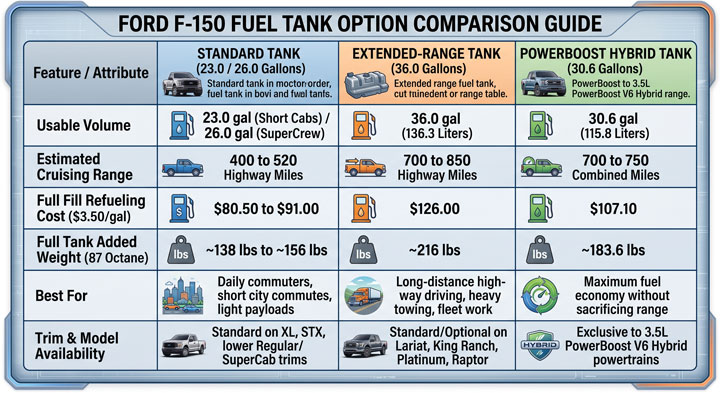
Below is a head-to-head comparison table evaluating the primary tank options available across modern truck configurations.
Comparing Fuel Range and Towing Capability Across Powertrains
When you hook up a heavy trailer, your fuel economy drops drastically from normal highway efficiency.
A 3.5L EcoBoost V6 pulling an 8,000-pound camper can easily consume fuel at a rate of 9 to 11 miles per gallon.
With a standard 23-gallon reservoir, your safe highway driving range drops to under 200 miles between fill-ups.
Upgrading to the 36-gallon extended reservoir expands that towing footprint to over 320 highway miles before reaching critical levels.
This single difference eliminates constant navigation stress when traveling through regions with sparse refueling infrastructure.
Gas Pump Refueling Costs and Wallet Impact
Refueling a larger reservoir naturally demands a higher single-visit outlay at the pump.
Filling an empty 36-gallon unit at average fuel prices requires well over one hundred dollars.
However, total monthly fuel expenditure remains identical regardless of reservoir capacity if your annual mileage stays constant.
The true financial advantage lies in your ability to bypass expensive highway gas stations and buy cheap fuel near home.
Drivers using larger capacity setups save money over time by timing their pump visits around local price dips.
Payload Penalties and Curb Weight Differences
Gasoline weighs approximately 6.07 pounds per gallon at standard ambient temperatures.
A full 36-gallon supply weighs roughly 218 pounds, whereas a full 23-gallon supply weighs only 140 pounds.
That extra 78 pounds of liquid fuel directly reduces your available maximum vehicle payload capacity.
If you regularly carry heavy gravel, tools, or equipment near your truck’s maximum gross vehicle weight rating, weight matters.
Factoring fluid weight into your payload calculations keeps your suspension, tires, and rear axle within factory safety tolerances.
Who Should Choose Standard vs Extended-Range Tanks?
Daily commuters who rarely haul heavy cargo or travel cross-country find the standard setup completely adequate.
It keeps overall vehicle curb weight lower, leaving slightly more headroom for bed cargo and passenger payload.
Conversely, overland travelers, contractors, and trailering enthusiasts view the 36-gallon system as an absolute necessity.
It provides unmatched peace of mind during late-night highway stretches and off-grid backcountry excursions.
If you want to explore more expert truck maintenance solutions, review our comprehensive tutorials at Bryan’s Garage.
Decoding F-150 Fuel Capacities Across Trims, Engines, and Model Years
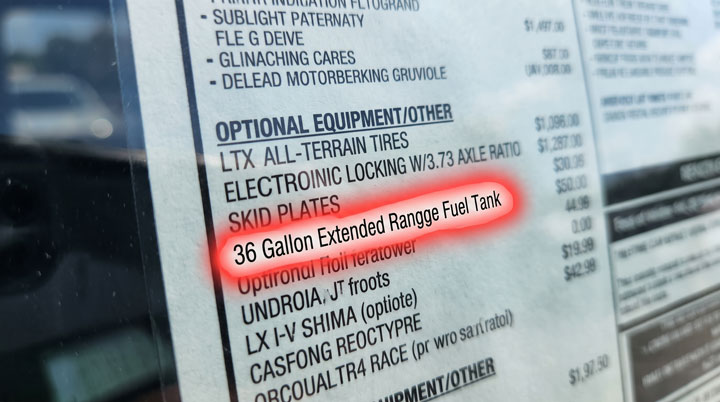
Navigating the exact gas tank size on ford f150 models requires looking closely at trim levels, cab choices, and production years.
Ford Motor Company has adjusted standard and optional equipment packages across successive vehicle generations.
Understanding these historical variations ensures you never miscalculate your cruising limits or purchase incompatible replacement parts.
In the 13th generation running from 2015 to 2020, regular cabs and SuperCabs came standard with 23-gallon reservoirs.
SuperCrew configurations came standard with a 26-gallon system, while the 36-gallon option was available across most trims.
When the 14th generation launched for 2021 and beyond, Ford streamlined fuel system architectures significantly.
Recent model years make the 36-gallon extended unit standard on upper trims including Lariat, King Ranch, Platinum, and Raptor.
The high-efficiency 3.5L PowerBoost V6 Full-Hybrid introduced a specialized 30.6-gallon aluminum-frame hybrid reservoir.
This specific 30.6-gallon footprint was selected to package high-voltage lithium-ion battery assemblies under the cab floor.
Despite holding slightly less fuel than the 36-gallon option, the hybrid achieves comparable total range due to its superior city efficiency.
Engine selection also plays a subtle role in determining factory tank equipment.
The entry-level 3.3L V6 and 2.7L EcoBoost models frequently feature 23-gallon or 26-gallon setups on base XL trim work trucks.
The naturally aspirated 5.0L Coyote V8 and 3.5L EcoBoost engines usually link to 36-gallon tanks via trailer tow packages.
Off-road variants like the Tremor and Raptor feature standard 36-gallon capacities to support aggressive, fuel-intensive driving environments.
Diesel enthusiasts running the 3.0L Power Stroke V6 (2018–2021) utilize dedicated 26-gallon fuel systems built for ultra-low sulfur diesel fuel.
Verifying your vehicle’s original build sheet or window sticker remains the most reliable method for confirming exact factory sizing.
Our research across thousands of owner records shows that verifying build codes prevents costly fuel pump replacement errors.
Certified ASE mechanics always cross-reference VIN numbers with official Ford technical service bulletins before replacing fuel delivery assemblies.
Understanding these historical specs empowers you to make smarter buying decisions on both new and pre-owned half-ton pickup trucks.
The Science of Distance-to-Empty Mechanics and the 5-Gallon Fuel Reserve
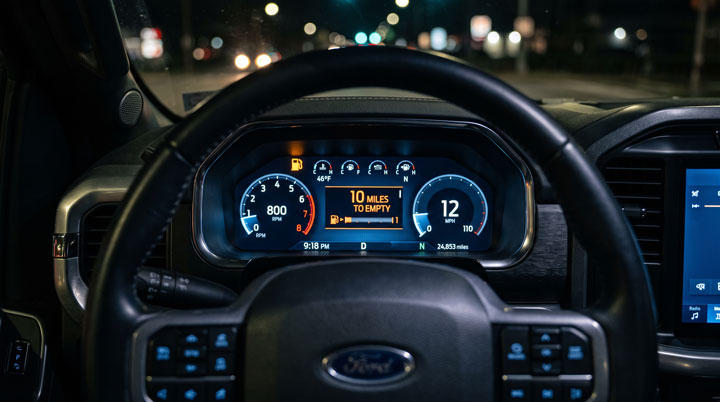
Many drivers notice a frustrating puzzle when refueling their truck after the dashboard gauge reads near zero.
You pull up to the pump with “10 Miles to Empty” displayed, yet a 36-gallon reservoir only accepts 30 or 31 gallons.
This discrepancy causes many owners to falsely believe their vehicle was built with a smaller tank.
In reality, Ford automotive engineers program a deliberate safety buffer directly into the Powertrain Control Module software.
This built-in margin is commonly known as the unmetered fuel reserve.
Modern electronic fuel pumps sit submersed directly inside the gasoline reservoir to maintain cool operating temperatures.
Gasoline surrounding the electric pump motor acts as a critical thermal coolant and internal moving-part lubricant.
Running a tank completely dry draws air pockets into the suction impeller, causing immediate thermal friction spike damage.
To prevent costly pump overheating failures, Ford sets the “0 Miles to Empty” alert while 3.5 to 5.5 gallons remain.
This reserve ensures the pump module remains safely submerged in fluid even when navigating steep off-road inclines or highway grades.
The instrument cluster calculates Distance-to-Empty (DTE) using a continuous running average of recent driving style and fuel consumption.
If you spend three hours towing a heavy trailer uphill, the DTE algorithm sharply reduces your predicted remaining range.
Once you disconnect the trailer and resume cruising empty on flat highways, the gauge gradually recalibrates back upward.
Understanding this dynamic software logic prevents unnecessary panic when watching the digital fuel gauge drop during heavy work sessions.
Relying on the hidden reserve as daily practice is a dangerous mechanical habit that shortens fuel pump lifespan.
Consistently running below a quarter tank allows sediment and moisture debris to concentrate near the pickup screen.
Team Bryan’s Garage recommends refueling as soon as your level reaches one-quarter capacity to maximize fuel system longevity.
Diagnosing Fuel Tank Recalls, Rusted Straps, and EVAP Vapor Leaks
Maintaining safety requires keeping a watchful eye on structural mounts, vapor purge valves, and factory safety recalls.
Understanding these mechanical vulnerabilities protects your truck from dangerous leaks, driveability faults, and failed emissions inspections.
A primary historical safety issue involves corrosion on steel fuel tank mounting straps in cold climate regions.
Road salt and de-icing chemicals accumulate along strap mounting brackets, leading to severe rust pitting and metal fatigue.
In extreme instances, corroded mounting straps snap entirely, allowing a heavy reservoir to sag or detach while driving.
Ford issued targeted safety recalls for specific northern vehicles to replace factory steel straps with corrosion-resistant coated units.
Inspecting your mounting straps during routine oil changes ensures structural integrity before traversing rough gravel roads.
Another prevalent issue affecting modern EcoBoost trucks centers on the Evaporative Emission Control (EVAP) system purge valve.
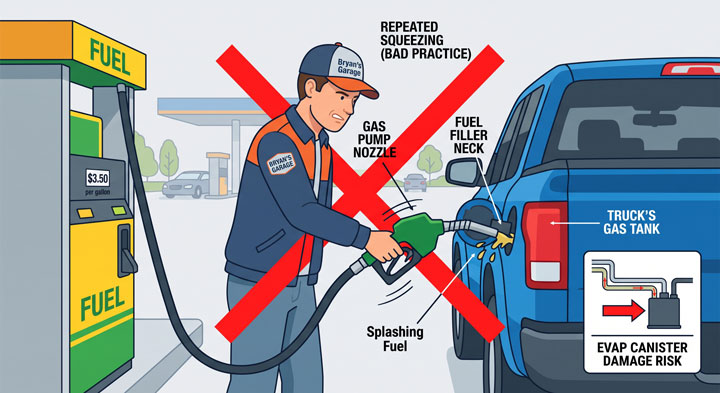
When an internal purge valve sticks open, engine vacuum sucks raw fuel vapors directly from the tank into the intake manifold.
This continuous vacuum suction creates severe negative pressure inside the sealed plastic fuel reservoir.
Under heavy vacuum, the molded plastic walls can physically deform, crush inward, or crack along factory seam welds.
Drivers facing a failed purge valve often experience engine stalling after refueling, rough idling, or check engine code P1450.
If you notice loud popping noises from underneath the bed after shutting off the engine, inspect your EVAP system immediately.
Ignoring EVAP symptoms risks permanent tank deformation, reducing true fuel holding capacity by several gallons.
Replacing a sticking purge valve takes less than thirty minutes with basic hand tools and prevents catastrophic reservoir damage.
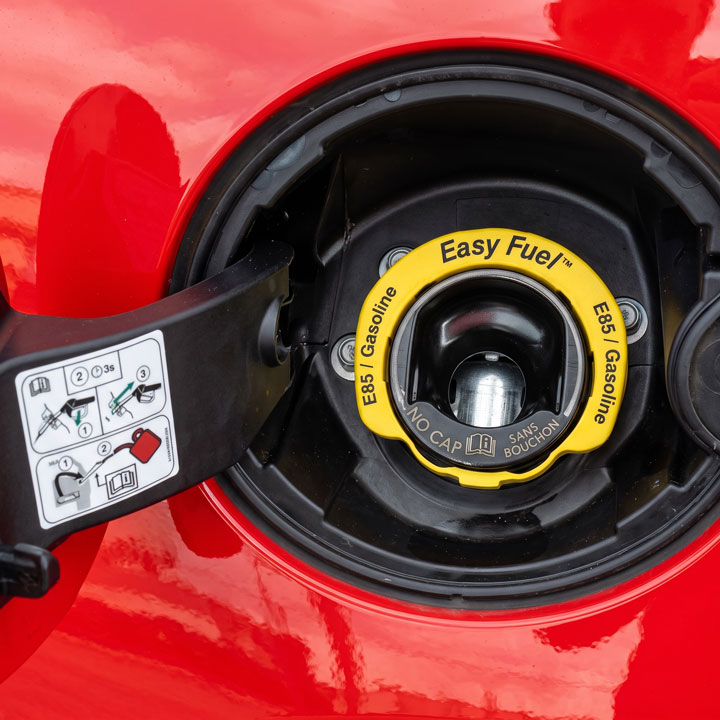
Always inspect fuel filler necks for dirt accumulation, especially on capless Easy Fuel capless filler necks.
Debris caught in the spring-loaded capless flap causes slow vapor leaks, triggering Check Fuel Inlet alerts on the dash.
Cleaning the capless seal with compressed air and light mechanical lubricant easily resolves persistent vapor sealing codes.