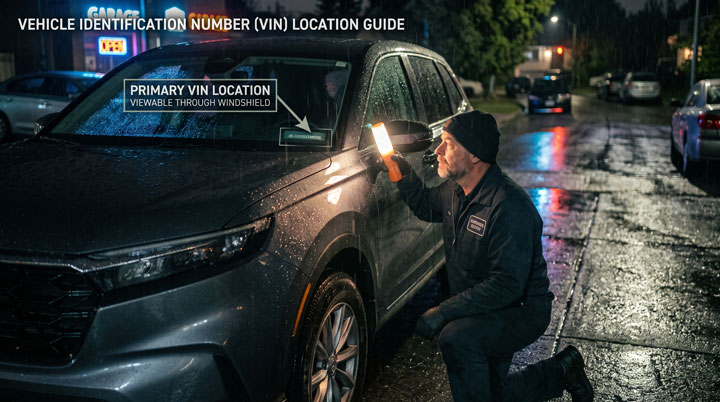
I still remember standing in a rain-slicked driveway holding a greasy flashlight, staring at a used Honda CR-V that claimed to be a clean, low-mileage EX-L trim with all-wheel drive, only to discover later that half its factory options were aftermarket knockoffs and the engine wasn’t original.
That costly mistake sent me down a deep automotive rabbit hole, but it led our team at Bryan’s Garage to master every digit of the honda crv vin decoder system so you never have to fall for mislabeled trim levels or hidden structural secrets again.
Honda CRV VIN Decoder Location and Factory Build Specs Guide
In This Article
How to locate every stamped and printed VIN tag on your Honda CR-V
Step-by-step 17-digit Honda CR-V VIN decoding manual for factory specs
Decoding assembly plant origins, trim levels, and engine codes across generations
How to spot stolen, cloned, or flood-damaged used CR-Vs using factory build codes
Expert tips for performing a complete VIN history and safety recall audit
🔴 MOST OWNERS NEVER FIND THIS
Your CR-V has a secret trick that starts the SUV when your key fob dies. And 14 other things Honda never told you.
Dead fob fix · Global window down trick · The hidden folding picnic table · Walk Away Auto Lock · and 11 more.
Vehicle cloning occurs when thieves replace a stolen car’s VIN plates with numbers from a legally registered, non-stolen vehicle.
To detect cloning, inspect the windshield VIN plate rivets under bright light.
Factory Honda windshield VIN plates use specialized rosette rivets that feature distinct star-shaped center impressions.
If you see standard pop rivets, scratched metal edges, or crooked alignment, walk away from the purchase immediately.
Always compare the windshield VIN against the B-pillar driver door decal and the stamped firewall metal number.
All three physical locations must display matching character strings without variation.
Next, pull back the carpet edge near the front passenger seat frame to verify the hidden stamped floorboard VIN.
Check for signs of fresh welding, non-factory seam sealer, or fresh paint around structural stampings.
These signs often indicate major collision repairs, structural sectioning, or attempts to mask altered numbers.
Connect an OBD2 diagnostic scan tool to the port located beneath the driver’s side dashboard line.
Read the electronic VIN stored inside the Engine Control Module (ECM) or Powertrain Control Module (PCM).
The electronic VIN stored in the computer computer must match the physical metal plates on the body.
A mismatch indicates the engine computer was replaced or that the vehicle’s body plates were swapped.
Finally, check the decoded engine displacement against the physical engine code stamped into the lower block.
Honda engine blocks feature codes like B20Z2, K24A1, or L15B7 stamped near the transmission bellhousing flange.
Verifying these details ensures the vehicle retains its original engine rather than a lower-spec replacement.
Practical Application Guide & Expert Tips
Applying VIN decoding knowledge during field inspections requires a methodical physical examination strategy.
Follow these practical steps whenever you inspect a Honda CR-V at a private sale or used vehicle lot.
Honda CRV VIN Decoder Location and Factory Build Specs Guide
Step 1: Perform the Three-Point Physical Tag Alignment Test
Locate the windshield plate, B-pillar decal, and firewall metal stamping.
Write down all 17 characters from each location independently on a piece of paper.
Compare the three written codes character by character to confirm complete consistency.
Any discrepancy between these tags indicates hidden structural repairs, body panel replacements, or title fraud.
Step 2: Calculate and Validate the Position 9 Security Check Digit
Understand that position 9 uses a weighted mathematical formula based on the surrounding 16 characters.
Enter the full VIN string into an online NHTSA or official manufacturer validation lookup tool.
If the check digit fails validation, the code is invalid or altered.Never purchase a vehicle with an invalid check digit code.
Step 3: Confirm Original Powertrain Specs Against the Block Stamp
Decode character 8 to confirm the factory engine type and displacement.
Shine your flashlight down onto the front engine block cast pad near the dipstick or bellhousing.
Confirm that the cast engine code matches the decoded engine family from position 8.
Step 4: Audit Paint and Trim Option Codes on the Door Jamb Label
Locate the color code printed at the bottom edge of the B-pillar door decal.
Honda paint codes follow formats like NH-731P (Crystal Black Pearl) or B-588P (Obsidian Blue Pearl).
Inspect door jambs, engine bay edges, and trunk floor seams for underlying paint colors.
Mismatched paint colors underneath trim panels indicate complete resprays following major accidents.
Step 5: Execute an Open Safety Recall and Service Campaign Scan
Enter the verified 17-digit string into the official Honda Owner Recall portal.
Review all uncompleted safety recall campaigns for airbag modules, fuel pumps, or rear trailing arm rust issues.
Schedule an appointment with an authorized dealer to complete open safety recalls free of charge.
Overcoming Risks & Common Mistakes
Honda CRV VIN Decoder Location and Factory Build Specs Guide
Misinterpreting vehicle identification codes can lead to expensive part ordering mistakes or poor buying decisions.
One common error is confusing the 10th-digit model year code with the vehicle’s physical manufacturing date.
A CR-V manufactured in November 2016 carries an ‘H’ in position 10, designating it as a 2017 model year vehicle.
Ordering brake pads or suspension struts based on the door tag build month rather than the 10th-digit model year often leads to incorrect parts.
Another major mistake is assuming all Japanese-branded CR-Vs are assembled in Japan.
Assuming a vehicle was built in Japan without checking position 1 can lead to ordering wrong market-specific components.
North American CR-Vs assembled in Ohio (L), Indiana (E), or Canada (H) feature specific wiring harnesses and brake suppliers.
Always verify position 11 before ordering chassis electrical items, lighting assemblies, or body clips.
Buyers also frequently overlook rust-related service bulletins on older CR-Vs from northern regions.
Failing to inspect trailing arm mounting points on Canadian or Midwestern vehicles can result in purchasing structurally unsafe cars.
Following Bryan’s Garage guidelines protects you from these common buying traps and ensures accurate parts selection every time.
🟢 Going viral on CR-V Owners Club & Reddit
“I’ve driven a CR-V for 4 years and didn’t know this existed.” — The most common reaction when this article is shared
15
features
1997+
models
15 min
read
Free
no signup
Did you know your backup camera has a hidden top-down ‘drone view’? Or that your cruise control automatically downshifts on steep mountain hills to save your brakes?
Frequently Asked Questions About Honda CR-V VIN Decoding
Where is the VIN located on a Honda CR-V?
The primary VIN is located on a metal plate visible through the bottom driver-side corner of the front windshield.
Secondary tags are located on the driver-side B-pillar door jamb and stamped directly onto the engine firewall bulkhead.
On newer models, an additional frame stamp can be found beneath the front passenger seat floor carpet panel.
How do I know what trim level my Honda CR-V is from the VIN?
Inspect digits 7 and 8 within the Vehicle Descriptor Section of your 17-character VIN.
Position 8 maps directly to factory equipment grades like LX, EX, EX-L, Touring, or Sport Hybrid.
Cross-referencing position 8 with factory trim charts reveals the vehicle’s original trim designation.
Which character in a Honda CR-V VIN shows the model year?
The 10th character in the 17-digit sequence designates the official model year.
Letters and numbers follow a standardized regulatory cycle where ‘H’ equals 2017, ‘K’ equals 2019, and ‘P’ equals 2023.
The letters I, O, Q, U, and Z are never used in model year designations to avoid confusion with numbers.
How can I tell where my Honda CR-V was manufactured?
Check the 1st and 11th characters of your vehicle identification string.
Position 1 shows the country of origin (‘1’, ‘4’, ‘5’ for USA, ‘2’ for Canada, ‘J’ for Japan).
Position 11 indicates the specific assembly plant, such as ‘L’ for East Liberty, Ohio, or ‘H’ for Alliston, Ontario.
Can a Honda CR-V VIN reveal if the car has open recalls?
Yes, entering your complete 17-digit VIN into the NHTSA lookup tool reveals all uncompleted safety recall campaigns.
The system displays active safety notices for items like airbag inflators, fuel pumps, and structural components.
Honda dealers perform all official recall repairs free of charge regardless of vehicle age or ownership history.
Final Verdict from Bryan’s Garage
Mastering your Honda CR-V’s factory identification numbers gives you full control over maintenance, parts ordering, and pre-owned vehicle purchases.
Ready to turn car care from a stressful chore into an easy DIY experience?
Explore more maintenance guides and expert repair insights at Bryan’s Garage.
Note: Individual results may vary depending on individual vehicle makes, models, year of manufacture, and overall condition. This article is intended for general automotive reference purposes only and does not replace official manufacturer service manuals or advice from a certified mechanic.