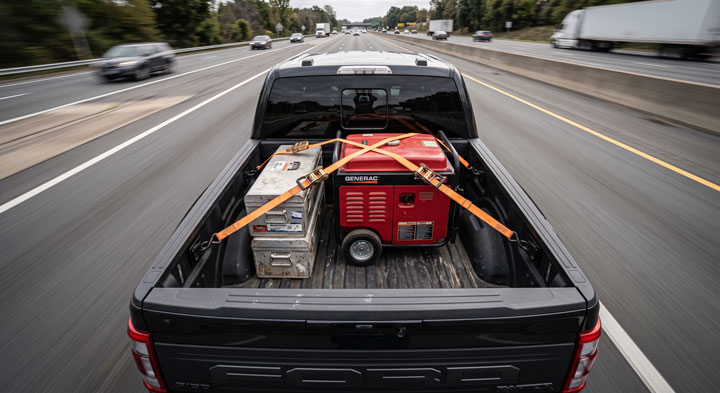
I remember the sudden heart-stopping thud from my truck bed as a loose generator slid into the tailgate during an emergency braking maneuver on the highway.
Like many Ford owners, I realized that securing cargo requires reliable ford f150 tie down anchors rather than flimsy plastic hooks.
That harrowing experience drove Team Bryan’s Garage to test every bed cleat system, offering practical, money-saving advice so you can haul gear safely without overspending at dealerships.
In This Article
- Detailed evaluation of the 7 best Ford F150 cargo tie-down anchor systems.
- In-depth comparison between OEM BoxLink plates and lower bed corner factory tie-downs.
- Mechanical breakdown of diagonal versus horizontal load weight ratings.
- Crucial guidelines for avoiding galvanic corrosion on aluminum F-150 truck beds.
- Step-by-step DIY installation and preventative maintenance procedures.
Your F-150 has a secret slot that starts the truck when your key fob dies.
And 8 other things Ford never told you.
Dead fob fix · Remote window trick · 7.2 kW generator hiding in your bed · Tailgate ladder · and 5 more.
▶ Read Now — Show Me Everything
bryansgarage.com · Bryan Mark · 2026
The 7 Best Ford F150 Tie Down Anchors and Cleat Systems: Ranked & Reviewed
Selecting the correct cargo securement hardware depends heavily on what you haul every day.
Modern Ford trucks come with specialized mounting mounting plates, but aftermarket innovations have expanded the options dramatically.
Our team at Bryan’s Garage analyzed weight limits, installation ease, material quality, and real-world durability across top market options.
1. OEM Ford BoxLink Locking Cleat System (HL3Z-99000A64-A)
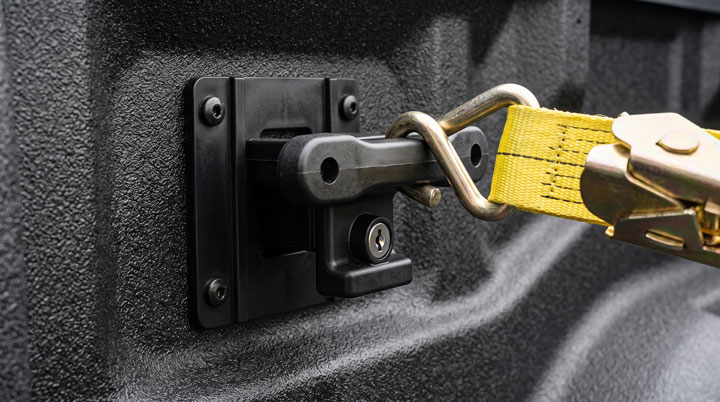
The original factory equipment option remains a gold standard for multi-purpose cargo securement.
Constructed with die-cast zinc inner bodies housed in high-impact composite housings, these cleats slide directly into factory BoxLink wall plates.
They offer physical key locks that prevent opportunistic theft when leaving expensive gear in open beds.
They are best suited for truck owners seeking direct factory fitment with integrated key security.
One limitation is that the key mechanism can seize over time if exposed to harsh winter road salts without regular lubrication.
2. Bull Ring Retractable Bed Rail Tie Down Anchors
Bull Ring anchors snap into the upper stake pockets along the top of the bed rails.
These stainless steel ring anchors snap upward when you need to attach ratchet straps and sit flush when not in use.
They provide an elevated tie-down angle, making them perfect for securing tall loads like refrigerators, motorcycles, or ladders.
While extremely durable and rated for up to 1,000 pounds, they require trim cutting on short-bed models without pre-cut plastic rail caps.
While competitor kits charge extra for installation tools, our team at Bryan’s Garage often reminds owners that a simple router bit or utility knife easily opens up those stake pockets at home.
3. Heavy-Duty E-Track Steel O-Ring Spring Fittings
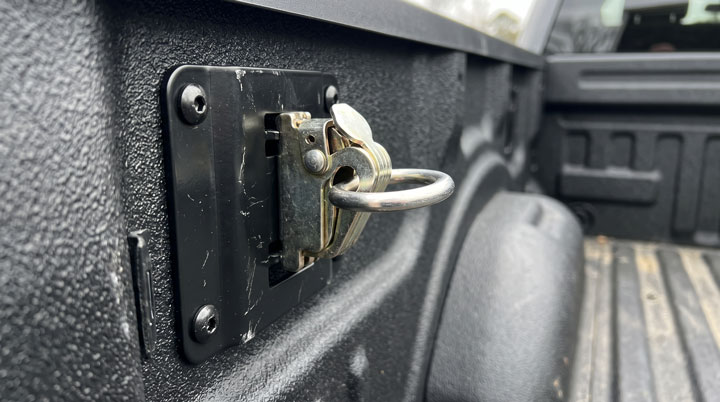
Many F-150 owners overlook the fact that Ford designed BoxLink interface plates to be fully compatible with standard 2-inch E-Track fittings.
These commercial-grade steel spring-loaded anchors clip directly into the slots of your factory BoxLink wall plates.
They provide robust steel O-rings capable of accommodating thick heavy-duty ratchet strap hooks.
This design is ideal for contractors and commercial haulers who need quick-release connections for heavy machinery.
However, they lack integrated key locks, meaning anyone can detach the spring clip if your truck bed is left unattended.
4. RedRock 4×4 Heavy-Duty Bed Tie Down Anchors
RedRock offers direct aftermarket replacements for factory BoxLink cleats built with solid steel bodies and a black powder-coated finish.
These units eliminate composite plastic components in favor of full structural steel construction.
They excel at resisting severe impact loads from shifting heavy construction debris or rock loads.
They are best for off-road enthusiasts and heavy material haulers who demand maximum impact resistance.
The primary drawback is that the powder coat can chip under heavy metal-on-metal strap contact, exposing raw steel to atmospheric rust.
5. Dee Zee Hex Series Truck Bed Cleats
Dee Zee utilizes extruded aluminum channels featuring sliding hex tie-down points.
These anchors attach along the inner bed walls or stake pocket channels, allowing infinitely adjustable tie-down positions.
This system caters specifically to overlanding rigs and truck camping setups requiring precise strap positioning for custom coolers or fuel cans.
They offer excellent resistance against atmospheric corrosion due to their solid aluminum alloy construction.
A notable trade-off is the higher installation cost and the requirement to align individual sliding T-bolts during initial mounting.
6. Ford Factory Lower Bed Corner Anchor Brackets
Located near the floor in all four corners of the bed, these fixed steel loops are standard factory equipment.
They attach directly to structural reinforcement pillars behind the bed wall sheet metal.
These lower anchors are ideal for tying down heavy items like ATVs, lawnmowers, or engines where low center-of-gravity anchor points are required.
They provide exceptionally high tensile strength without relying on removable plastic housings.
Their lower placement makes them less convenient when securing tall cargo that extends well above the bed rails.
7. Folding Aluminum Stake Pocket Cargo Tie-Down Cleats
Folding bed rail cleats mount inside the top bed stake pockets and fold flat when not in use.
Made from cast aluminum alloys, they provide quick hook attachment points for cargo nets and light ropes.
They are perfect for weekend DIYers hauling light yard waste, camping gear, or furniture.
They add sleek aesthetic appeal to the upper bed rail without protruding into cargo space.
However, they are not designed for extreme diagonal tension from heavy-duty ratchet straps and may bend under extreme loads.
To help you choose the right cargo securement hardware for your truck, we compiled this comparison breakdown.
| Anchor System | Estimated Price | Installation Complexity | Effectiveness & Load Rating |
|---|---|---|---|
| OEM Ford BoxLink Cleats | $65 – $90 (Set of 4) | Easy (Toolless Slide-In) | Excellent (275 lbs Cross / 600 lbs Diagonal) |
| Bull Ring Retractable Anchors | $30 – $50 (Pair) | Moderate (Stake Pocket Snap) | Superior (1,000 lbs Breaking Strength) |
| E-Track Steel O-Ring Clips | $15 – $25 (4-Pack) | Easy (Spring-Loaded Clip) | Heavy-Duty (1,000+ lbs Work Load) |
| RedRock 4×4 Steel Cleats | $50 – $70 (Set of 4) | Easy (Key-Lock System) | High (Heavy-Duty Steel Construction) |
| Dee Zee Hex Series Cleats | $80 – $120 (Set) | Moderate (Track System Bolt-On) | High (Adjustable Position System) |
| Ford Factory Lower Loops | Included OEM | Pre-Installed (Torx Screws) | Maximum (Structural Frame Anchor) |
| Folding Stake Pocket Cleats | $25 – $40 (Pair) | Easy (Expansion Bolt) | Moderate (Light to Medium Duty) |
If you want to handle cargo organization safely at home, check out our full library of practical guides at Bryan’s Garage.
Understanding Ford F150 Bed Anchor Mechanics: BoxLink vs Lower Corner Loops
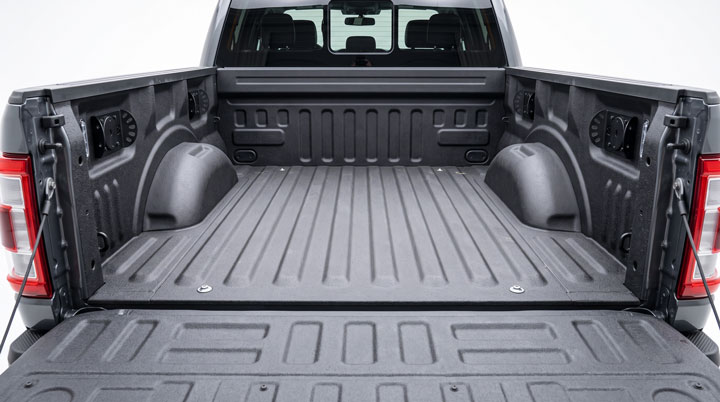
To haul loads safely, you must understand how your truck bed handles structural stress.
Ford equips modern F-150 trucks with two distinct types of cargo anchor systems from the factory.
The primary foundation consists of four fixed steel loops mounted near the bottom corners of the bed floor.
These lower corner anchors are secured with heavy Torx fasteners directly into reinforced structural bed pillars.
Because they are tied directly to lower structural frame points, they handle extreme pull tension.
When loading heavy rolling machinery like ATVs, riding mowers, or engine blocks, always anchor to these lower corner loops.
Starting in 2015, Ford introduced the BoxLink cargo management system situated higher up on the mid-bed sidewalls.
This system utilizes four heavy aluminum reinforcement plates mounted flush against the inner bed walls.
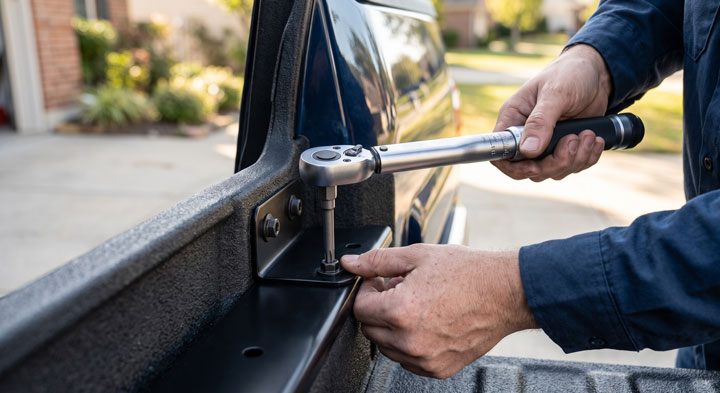
Each plate is attached to threaded bed inserts using four Torx T30 self-tapping bolts.
The BoxLink system was designed based on fleet customer feedback to provide mid-height anchor points.
Without mid-height anchors, tall cargo like toolboxes, ladder racks, or appliances tend to tip over during cornering.
The removable cleats slide upward into these plates and lock into place using specialized keys.
Engineering analyses confirm that using lower anchors in tandem with upper BoxLink cleats distributes strap tension across multiple plane angles.
This dual-zone anchor arrangement prevents cargo from sliding forward while simultaneously preventing top-heavy tipping.
The Science of Weight Ratings: Horizontal Cross-Bed Tension vs Diagonal Load Forces
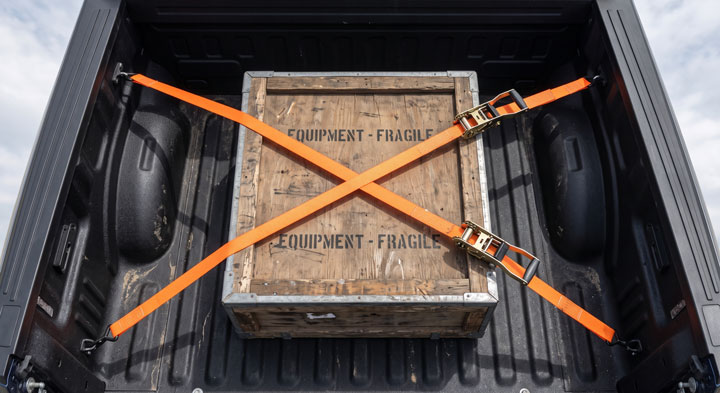
Exceeding cargo anchor weight limits can warp bed panels or snap securement fittings under highway vibration.
Ford Motor Company publishes specific engineering guidelines for f150 tie down anchors load capacities.
According to official Ford service documentation, each BoxLink cleat is rated for 275 pounds of horizontal cross-bed tension.
Horizontal cross-bed tension refers to pulling straight across the bed from the left cleat directly to the right cleat.
When applying diagonal strap tension, the mechanical load rating increases significantly to 600 pounds per cleat.
Diagonal pulling distributes force across both vertical shear vectors and horizontal tension vectors within the aluminum bed wall.
Understanding vector physics is critical when using high-leverage mechanical ratchet straps.
A standard 2-inch commercial ratchet strap can generate over 1,500 pounds of force with minimal hand effort.
If you crank a ratchet strap excessively tight straight across opposing BoxLink cleats, you risk bowing the aluminum bed sidewalls inward.
The aluminum bed metal flexes under extreme lateral force long before a steel interface plate shears off.
To maximize cargo hold without damaging your truck, crisscross your ratchet straps diagonally from front-left to rear-right anchors.
This technique utilizes the higher 600-pound diagonal load rating while stabilizing cargo against three-dimensional inertia forces.
Preventing Galvanic Corrosion: Steel Fasteners in Aluminum Truck Beds
In 2015, Ford revolutionized the light-duty truck segment by transitioning the F-150 body to military-grade aluminum alloy.
While aluminum offers huge weight savings and rust resistance, it introduces a chemical challenge known as galvanic corrosion.
Galvanic corrosion occurs when two dissimilar metals—such as carbon steel fasteners and aluminum bed sheet metal—come into direct contact in the presence of an electrolyte like water or salt spray.
When un-coated steel hardware is bolted into an aluminum bed wall, an electrochemical cell forms.
The aluminum acts as an anode and slowly oxidizes, creating white powder buildup around fastener holes.
Over time, this chemical reaction weakens the threaded mounting points holding your ford f150 BoxLink anchors to the frame.
To prevent galvanic degradation, Ford uses specially coated organic-zinc fasteners for factory BoxLink plates.
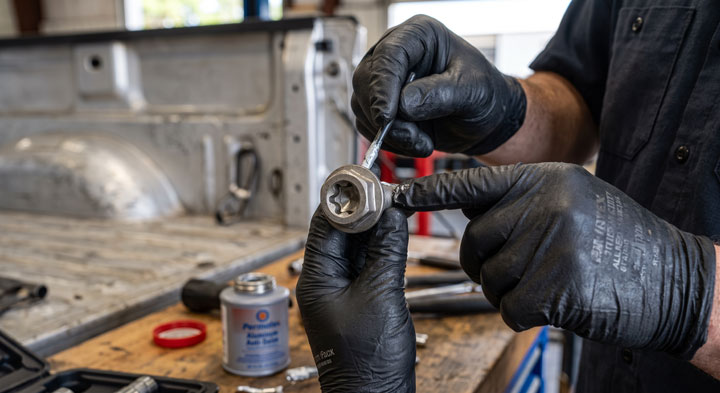
If you purchase aftermarket tie-down hardware, you must ensure the bolts are zinc-plated, stainless steel, or coated with an isolating layer.
When installing aftermarket anchors, Team Bryan’s Garage recommends applying a thin layer of anti-seize compound or thread-locking fluid onto fastener threads.
This fluid barrier prevents moisture intrusion and stops direct metal-to-metal chemical contact.
Inspect your bed wall mounting plates annually for white powdery residue or loose mounting bolts.
If corrosion appears, remove the interface plate, brush away oxidation with a nylon wire wheel, apply zinc-rich primer, and reinstall with fresh hardware.