
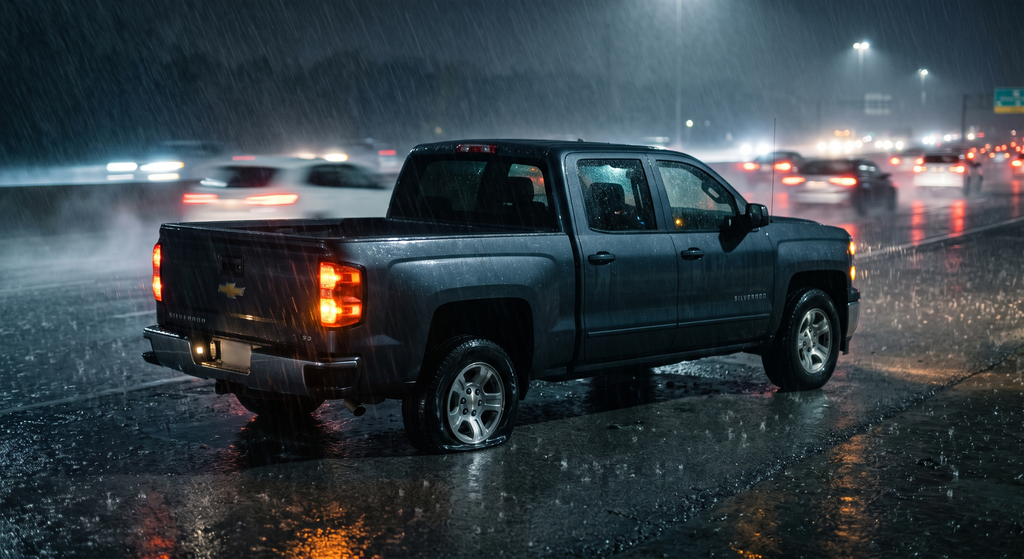
I still remember standing on the shoulder of a dark highway during a torrential downpour, desperately searching for the factory jack in my Chevy Silverado while headlights whizzed past.
That frustrating evening taught me how crucial it is to know your vehicle inside and out, especially when pinpointing your chevy silverado jack location jacking points guide. Here at Team Bryan’s Garage, we want to ensure you never get stuck guessing during a roadside emergency.
In This Article
- Step-by-Step Retrieval & Lifting Guide: How to access factory tools and safely elevate your truck.
- Factory Jack Storage Locations: Differences across Regular, Extended, Double, and Crew Cab configurations.
- Approved Frame Jacking Points: Exact front and rear load-bearing structural positions.
- Spare Tire Hoist Operation: Assembling extension rods to release the under-bed spare tire mechanism.
- Safety Mechanics & Equipment Comparison: Evaluating factory scissor jacks versus shop floor jacks and stands.
Your Silverado has a secret compartment hiding above your glove box.
And 8 other things Chevy never told you.
Hidden dash storage · Key fob window trick · Auto 4WD mode · Buckle to Drive · and 5 more.
▶ Read Now — Show Me Everything
bryansgarage.com · Bryan Mark · 2026

How to Locate the Jack and Jacking Points on Your Chevy Silverado: A Step-by-Step Guide
Before you begin raising a high-tonnage vehicle like the Chevrolet Silverado, proper preparation is vital.
Truck weight distribution presents unique mechanical dynamics compared to standard passenger cars.
Always park your Silverado on a hard, level concrete or asphalt surface.
Firmly engage the parking brake before attempting to loosen wheel lug nuts or lift the frame.
Place wheel chocks firmly behind and in front of the tire diagonally opposite to the one being changed.
Verify that your vehicle is shifted completely into Park for automatic transmissions or First gear for manual transmissions.
Step 1: Locate and Retrieve the Factory Scissor Jack Assembly
Finding your tools depends entirely on your truck’s cab style and model generation.
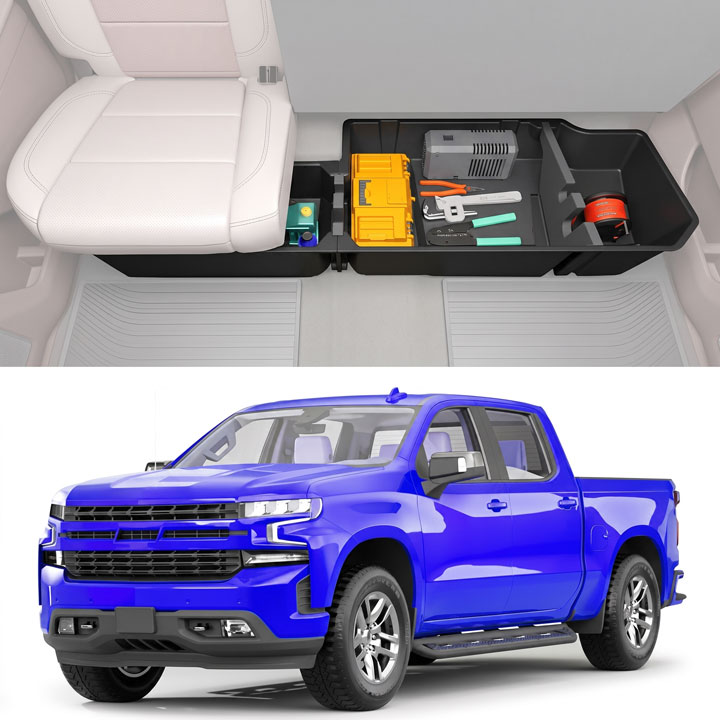
For Crew Cab and Double Cab models, flip up the rear passenger-side bench seat cushion to expose the floor storage bracket.
In older Extended Cab models, you will find the equipment secured behind the rear passenger seat backrest.
If you own a Regular Cab Silverado, locate the tool storage tray mounted directly behind the front passenger seat.
Look for the black plastic cover or heavy canvas tool pouch held down by wing nuts.
You can quickly locate your factory scissor jack under rear passenger seat compartments by releasing the plastic thumb screws.
Understanding where is the jack on a chevy silverado prevents lost time during unexpected flat tire incidents.
Step 2: Disassemble the Retaining Hardware and Retrieve Extension Rods
Unscrew the primary retention wing nut counterclockwise until the clamp frees from the floor stud.
Lift the heavy-duty scissor jack out of its mounting bracket carefully.
Unclip or unstrap the heavy canvas tool bag containing the multi-piece extension rods and lug wrench.
You will need to search the storage kit to find your wing nut hold down clamp extension rods find position.
Locate the heavy steel lug wrench inside the canvas bag to serve as your primary leverage handle.
Confirm that all three square-drive extension shafts are present and free of severe surface corrosion.
Checking your chevy silverado tire iron location inside the bag guarantees you have proper leverage for wheel lug torque.
Step 3: Assemble Extension Rods to Operate the Spare Tire Hoist
Assemble the square-drive extension rods by snapping the spring-loaded locking pins into their mating slots.
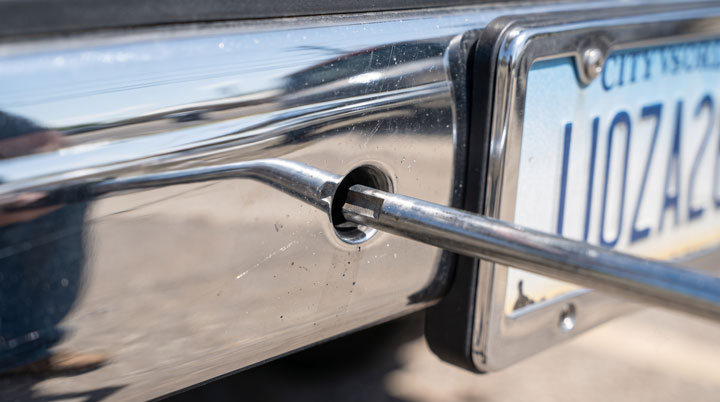
Walk to the rear bumper of your Silverado and locate the small key-lock cylinder beside the license plate.
Insert your ignition key into the lock, turn it clockwise, and pull the lock cylinder straight out.
Slide the hooked or square end of the assembled extension rod straight through the bumper access hole.
Guide the rod into the funnel-shaped guide tube until it fully engages the spare tire winch mechanism socket.
Attach the lug wrench handle to the outer end of the shaft assembly.
Rotate the assembly counterclockwise to trigger the internal winch, lowering the spare tire to the pavement.
Using these extension rods operating tire hoist chevy mechanisms allows smooth lowering without damaging underbody wiring.
Continue cranking until sufficient cable slack allows you to tilt and slide the steel retainer bar through the wheel center hub.
Step 4: Position the Jack at Approved Structural Frame Lift Points
Never place a lifting jack under body sheet metal, steering components, or thin floor pans.
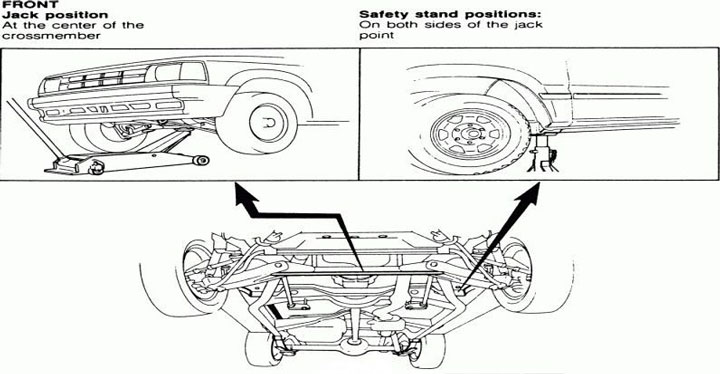
For front wheel lifting, locate the heavy steel hydroformed box frame section directly behind the front wheel well.
Position the jack pad flat against the flat bottom section of the main frame rail or front crossmember.
For rear wheel lifting, place the curved saddle of the factory jack directly under the solid rear axle tube.
Position the saddle as close as safely possible to the leaf spring mounting bracket on the affected side.
Double-check your alignment against official frame jacking points front rear location chevy schematics before applying pressure.
Ensure the jack base sits completely flat on firm ground to prevent dangerous slippage under heavy load.
Step 5: Safely Elevate the Silverado and Position Mechanical Jack Stands
Turn the jack drive screw clockwise by hand until the top saddle contacts the designated lifting point.
Insert the lug wrench handle into the loop end of the jack screw mechanism.
Rotate the handle clockwise in smooth, controlled continuous rotations to raise the vehicle.
Lift the truck only high enough so the flat tire clears the ground by roughly one to two inches.
Slide a heavy-duty rated mechanical jack stand directly under the solid frame rail or axle housing adjacent to the jack.
Slowly lower the vehicle onto the jack stand by turning the jack screw counterclockwise until the stand bears weight.
Learning how to safely lift truck roadside flat tire chevy situations guarantees maximum safety for you and your vehicle.
Never rely solely on a hydraulic floor jack or scissor jack to hold a raised truck while working underneath.
Bryan’s Garage Expert Tip: Performing basic maintenance at home should never involve guesswork or risky lifting techniques. If you want to explore more professional truck care solutions, visit Bryan’s Garage for trusted DIY guides and mechanical insights.
Technical Breakdown of Chevy Silverado Frame Mechanics and Lift Locations
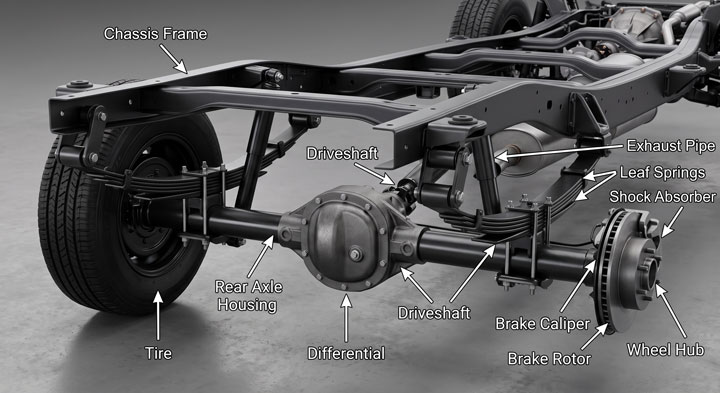
The Chevrolet Silverado relies on a full-length, ladder-style steel frame built to support high payload capacities.
GM utilizes advanced hydroforming techniques to construct rigid, boxed frame rails from the front bumper to the rear axle.
Understanding structural load pathways is essential when choosing mechanical lifting locations.
Hydroformed steel offers exceptional torsional stiffness, but concentrating vehicle weight on incorrect points can cause localized denting.
Front jacking points must account for the heavy mass of the V8 or Duramax diesel engine assembly over the front suspension.
The front frame crossmember provides a central structural point when using high-capacity floor jacks in shop environments.
However, roadside lifting with a factory scissor jack requires lifting one corner at a time on the outer frame rail.
The circular jack pad indicator stamped into modern Silverado frame rails highlights the exact manufacturer-approved contact zone.
Positioning your lifting device outside this zone risks contacting secondary components like fuel lines, brake lines, or body mounts.
Rear load distribution centers around the solid rear axle housing and heavy leaf spring suspension leaves.
The rear axle tube is engineered to support dynamic vehicle weight, making it an ideal point for bottle jacks and floor jacks.
Avoid placing lifting equipment directly under the cast aluminum rear differential cover found on modern half-ton models.
Point-loading the thin aluminum cover can crack the casing, causing immediate fluid leakage and severe gear failure.
Always align the jack saddle directly with the steel axle tube, placing it between the leaf spring u-bolts and shock absorber mounts.
Maintaining clean metal-to-metal contact prevents slipping caused by road grime, chassis grease, or undercoating buildup.
| Lifting Device Type | Weight Rating Capacity | Best Vehicle Application Zone | Primary Advantage & Usage |
|---|---|---|---|
| Factory Scissor Jack | 2.0 to 2.5 Tons | Side Frame Rails / Rear Axle Tube | Compact, emergency roadside use, stores under rear seat. |
| Hydraulic Floor Jack | 3.0 to 4.0 Tons | Front Crossmember / Differential Housing | Fast elevation, broad stable base, ideal for shop maintenance. |
| Heavy-Duty Bottle Jack | 4.0 to 12.0 Tons | Rear Axle Tubes / Heavy HD Frames | High vertical lift capacity, compact footprint for 2500HD/3500HD. |
| Ratchet Jack Stands | 3.0 to 6.0 Tons (Per Pair) | Main Frame Rails / Solid Rear Axles | Mandatory secondary safety support during underbody repairs. |

Generational Differences Across Silverado Models (1500, 2500HD, 3500HD & Cab Configurations)
Chevrolet Silverado designs have evolved significantly across four distinct vehicle generations over the past two decades.
First-generation GMT800 trucks produced from 1999 through 2006 featured traditional C-channel frame designs behind the cab.
GMT800 regular cab models store the jack and lug wrench behind the passenger seat, retained by a basic steel bracket.
Extended cab GMT800 trucks house the tool kit under the folding rear bench seat on the passenger side.
Second-generation GMT900 models built from 2007 to 2013 introduced fully boxed frame rails across the entire chassis length.
GMT900 models featured an updated canvas tool wrap with threaded wing nuts securing the scissor jack to floor studs.
Third-generation K2XX trucks manufactured from 2014 to 2018 refined interior storage solutions with dedicated plastic under-seat trays.
K2XX models also introduced a security key lock cylinder on the rear bumper to prevent spare tire theft.
Fourth-generation T1XX trucks launched in 2019 expanded cab dimensions, altering tool placement slightly across trims.
T1XX Double Cab and Crew Cab trucks place the jack kit inside a molded plastic bin under the rear right seat cushion.
Heavy-duty models including the Silverado 2500HD and 3500HD utilize larger capacity scissor or hydraulic bottle jacks from the factory.
HD trucks feature higher ground clearance, requiring greater mechanical lift extension to lift tires clear of the ground.
Never substitute a 1500 light-duty scissor jack onto a 2500HD or 3500HD truck, as weight thresholds will be exceeded.
HD frames feature thicker steel wall gauges, permitting jacking directly under heavy-duty suspension brackets and frame gussets.
Always consult your owner’s manual index to verify exact load limits based on your truck’s Gross Vehicle Weight Rating (GVWR).
The Science of Safe Truck Support: Scissor Jacks vs. Floor Jacks vs. Jack Stands
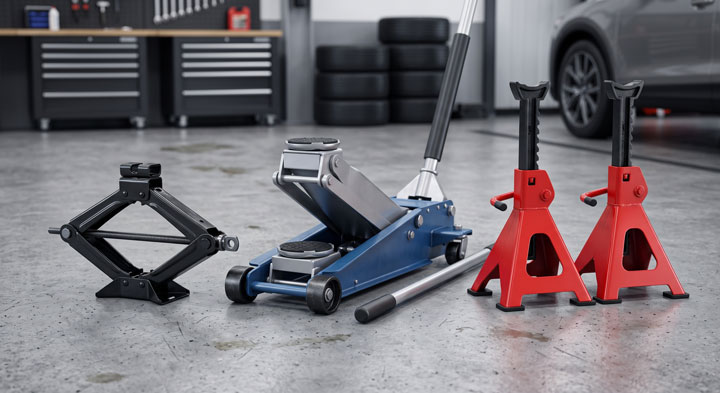
Using the correct lifting apparatus protects both human life and complex vehicle chassis components.
Factory scissor jacks utilize a lead-screw design that converts rotational force into mechanical vertical lift force.
While extremely compact and reliable for emergency tire changes, scissor jacks feature narrow bases that offer limited lateral stability.
Using a scissor jack on soft soil or sloped gravel increases the risk of the tool tipping sideways under load.
Hydraulic floor jacks rely on sealed fluid pressure to lift heavy vehicles quickly with minimal manual effort.
Floor jacks feature wide steel caster wheels that roll slightly as the lifting arm raises, maintaining central load alignment.
However, internal hydraulic seals can degrade over time, leading to sudden pressure drops without warning.
For this reason, a hydraulic jack should never be used as a standalone support device during repairs.
Mechanical jack stands utilize high-tensile steel pawls and cast iron support columns to lock height mechanically.
Once weight is transferred onto jack stands, hydraulic pressure failure risks are completely eliminated.
When placing jack stands under a Silverado, select solid frame rails or heavy rear axle housings.
Insert rubber jack pad adapters onto stand saddles to prevent scuffing the factory frame paint or protective wax undercoating.
Preventing frame paint damage stops moisture intrusion, protecting your chassis against severe structural rust formation.
Practical Application Guide: Emergency Roadside Flat Tire Replacement
Experiencing a flat tire on a busy highway requires fast, calm, and methodical execution of safety protocols.
Immediately pull your Silverado entirely off the roadway onto a wide, flat paved shoulder away from traffic lanes.
Turn on your hazard warning lights to signal your presence to approaching drivers night or day.
Set your emergency parking brake firmly to prevent the vehicle from rolling while elevated.
Gather your passengers and direct them to stand in a safe location far behind the highway guardrail.
Retrieve your wheel chocks, factory scissor jack, and assembled extension rods from under the rear seat.
Use the sharp end of your lug wrench to pop off the decorative center hub cap covering the lug nuts.
Loosen each wheel lug nut by turning it counterclockwise one full turn while the tire rests firmly on the ground.
Do not remove the lug nuts completely until the vehicle tire is fully elevated off the pavement surface.
Position your scissor jack under the frame rail or rear axle, turn the lead screw clockwise, and raise the truck.
Remove the loosened lug nuts, carefully pull the damaged wheel free, and mount the spare tire onto the wheel studs.
Thread the lug nuts back onto the studs by hand in a crisscross pattern until snug against the wheel rim.
Lower the truck until the tire lightly contacts the ground, then use your lug wrench to torque all nuts firmly.
Follow a star or crisscross pattern when tightening to ensure equal pressure distribution across the brake rotor hub.
Lower the vehicle completely to the ground, remove the jack, and stow all emergency tools securely back in their brackets.
Critical Risks and Common Mistakes to Avoid When Jacking Your Silverado
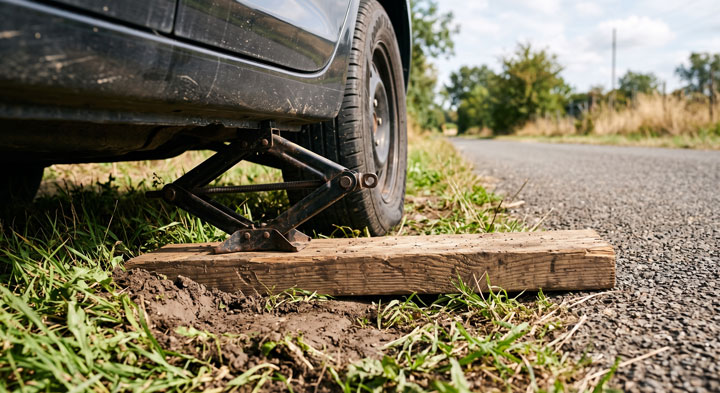
Improper jacking procedures can cause expensive structural chassis damage and severe personal injury.
One common mistake is placing the jack head against thin outer sheet metal rocker panels under the doors.
Lifting on sheet metal will instantly crush the rocker panel, causing thousands of dollars in body repair damage.
Another dangerous error involves placing the jack under steering linkage arms, tie rods, or front sway bars.
Steering components are not designed to support vehicle weight and will bend immediately under load.
Never attempt to lift your truck on soft dirt, mud, or uncompacted gravel without a thick wooden support base block.
A jack base will sink rapidly into soft ground, causing the vehicle to tilt and fall off the lifting pad.
Always place a 1.5-inch thick piece of solid plywood or hardwood plank beneath the jack on soft surfaces.
Avoid working under a raised vehicle supported only by a hydraulic floor jack without safety stands in place.
Hydraulic valves can bypass internal fluid under extreme pressure, causing the vehicle to drop unexpectedly.
Double-check that your Silverado is completely out of gear and that parking brake engagement is verified prior to lifting.

“I’ve driven a Silverado for 5 years and didn’t know this existed.”
— The most common reaction when this article is shared
Did you know there’s a hidden storage compartment behind your rear seats? Or the button combo that switches your digital cluster to a completely different layout?
bryansgarage.com · July 28, 2026
Frequently Asked Questions About Chevy Silverado Jacking Procedures
Where is the spare tire jack located on a Chevy Silverado Crew Cab?
On modern Silverado Crew Cab models, the factory scissor jack and tool kit are stored under the rear passenger-side seat cushion. You must lift the bottom seat cushion upward to access the plastic storage tray. Unscrew the wing nut retainer counterclockwise to release the jack and tool pouch.
Can I lift my Silverado by placing a jack directly under the rear differential?
You can use a broad hydraulic floor jack under the center rear differential housing on steel-cased axles. However, avoid point-loading modern aluminum differential covers. Always place a solid rubber pad or wooden block on your jack saddle to distribute lifting force evenly across the housing.
What is the correct torque specification for Chevy Silverado lug nuts?
Most modern Chevy Silverado 1500, 2500HD, and 3500HD trucks require wheel lug nuts to be torqued to 140 ft-lbs (190 Nm). Always use a calibrated torque wrench and tighten nuts in a star or crisscross pattern to prevent brake rotor warping.
How do I lower the spare tire if the bumper lock key is missing?
If your bumper lock cylinder key is lost, you can spray penetrating oil around the lock housing and use a large flathead screwdriver to pop out the retaining clip from behind the bumper. Alternatively, an automotive locksmith can rekey or bypass the lock cylinder quickly.
Why won’t my extension rod turn the spare tire hoist winch?
Over time, road dirt, water, and salt cause the spare tire winch mechanism to rust and seize. Spray high-quality penetrating lubricant into the hoist guide tube socket, let it soak for 15 minutes, and gently wiggle the extension rod back and forth to break the corrosion free.
Conclusion
Knowing how to locate your jack and identify approved frame lifting points transforms stressful roadside flats into simple, manageable maintenance tasks.
Ready to transform your car maintenance from a stressful chore into a breeze? Explore more tips at Bryan’s Garage. Have questions? Our team can help you find the best solutions for your car problems and avoid costly mechanic visits.
Note: Individual results may vary depending on individual vehicle makes, models, year of manufacture, and overall condition. This article is intended for general automotive reference purposes only and does not replace official manufacturer service manuals or advice from a certified mechanic.