I still remember the sheer frustration of standing in my driveway with a brand-new truck bed cover lying flat on my tailgate while rainwater dripped straight onto my power tools.
As a certified mechanic, I quickly realized that tackling a ford f150 bed cover installation requires precise rail alignment rather than brute muscle strength alone.
That exact rainy afternoon taught Team Bryan’s Garage the exact steps needed to help you install your tonneau cover perfectly without water leaks or costly auto shop bills.
In This Article
- Step-by-Step DIY Installation: Complete walkthrough for attaching side rails, securing bed clamps, and mounting the cover assembly safely.
- Cover Style Comparison: Evaluating hard tri-fold, soft roll-up, and retractable designs based on budget, durability, and cargo security.
- Bed Dimensions & Tailgate Clearance: How to accurately measure 5.5ft, 6.5ft, and 8ft beds across 12th, 13th, and 14th Ford F-150 generations.
- Weatherproofing & Leak Prevention: Proven mechanic secrets for installing bulkhead foam seals, tailgate weatherstripping, and drain hoses.
Your F-150 has a secret slot that starts the truck when your key fob dies.
And 8 other things Ford never told you.
Dead fob fix · Remote window trick · 7.2 kW generator hiding in your bed · Tailgate ladder · and 5 more.
▶ Read Now — Show Me Everything
bryansgarage.com · Bryan Mark · 2026
How to Perform a Ford F150 Bed Cover Installation: A Step-by-Step Guide
Installing a truck bed cover on your Ford F-150 is one of the most rewarding DIY upgrades you can complete in your own garage.
A properly fitted cover protects expensive gear from heavy rain, improves highway aerodynamics, and deters opportunistic theft.
Before turning a single wrench, you must gather the correct equipment and prepare your truck bed cap surfaces properly.
Prerequisites and Tools You Will Need
Most modern tonneau covers feature clamp-on designs that require no drilling into your F-150’s aluminum or steel bed rails.
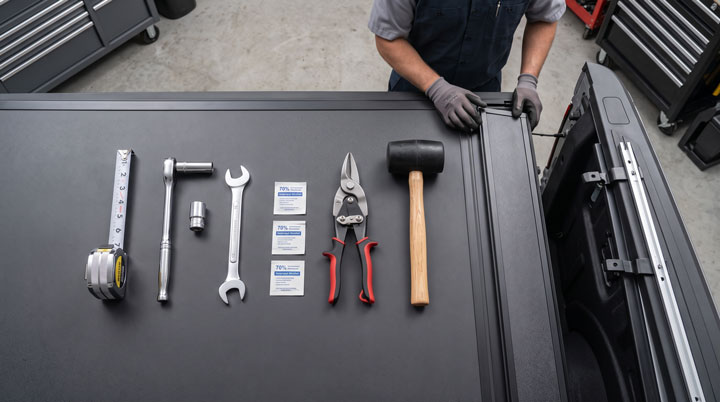
You will need a tape measure, a 1/2-inch socket wrench or combination wrench, alcohol prep pads, utility shears, and a rubber mallet.
Having a second pair of hands available makes placing heavy hard-folding or retractable canisters significantly easier and safer.
Ensure your truck bed caps and front bulkhead wall are thoroughly washed, dried, and cleared of dirt before starting installation.
Step 1: Measure Bed Box Dimensions and Clean Bed Rails
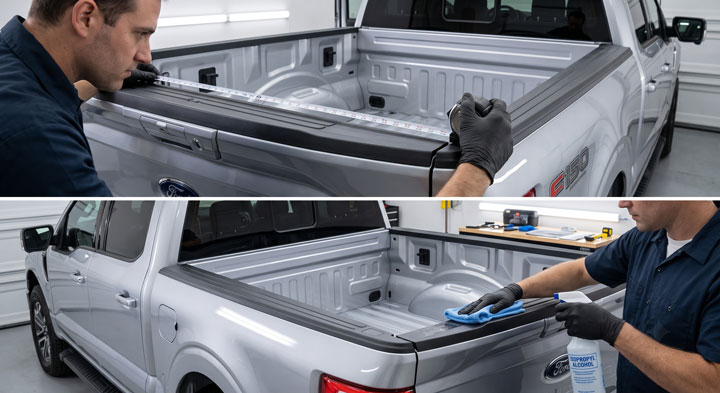
Begin by using your tape measure to verify your Ford F-150 cargo bed box length inside from bulkhead to closed tailgate.
Ford F-150 beds typically measure 5.5 feet (short box), 6.5 feet (standard box), or 8 feet (long box).
Clean the top plastic bed cap surfaces and the front bulkhead wall using isopropyl alcohol and a clean microfiber cloth.
Removing wax, oil, and road grit ensures that self-adhesive foam weather strips form an airtight, watertight bond.
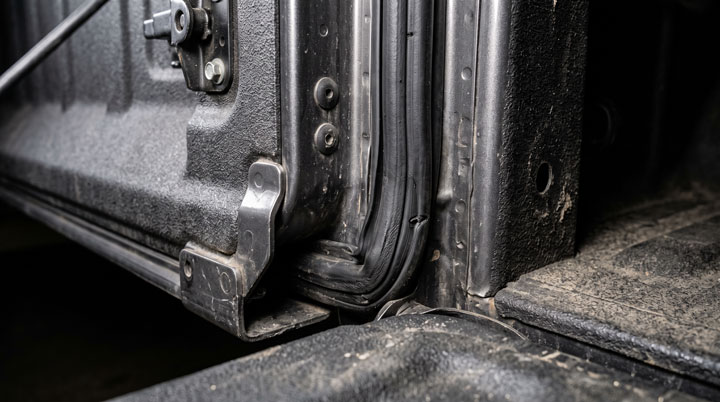
Step 2: Install the Bulkhead Weather Seal Strip
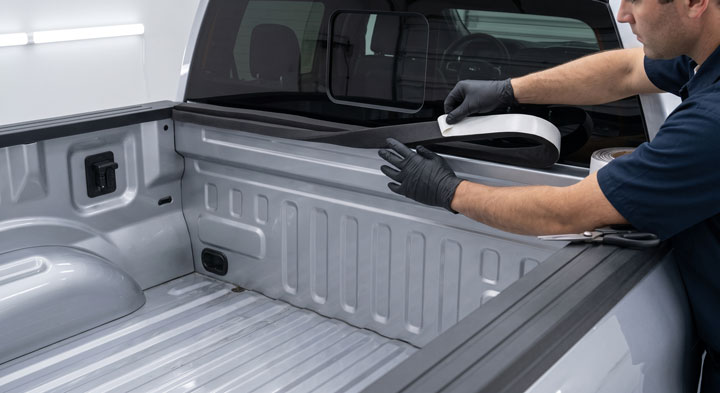
Locate the thick foam weatherseal strip included in your tonneau cover hardware kit.
Peel back the protective adhesive backing slowly as you lay the foam strip across the top of the front bed bulkhead wall.
Align the foam strip flush with the inside edge of the bulkhead, pressing down firmly along the entire length.
Use utility shears to trim off any excess foam seal so it fits perfectly between the left and right plastic bed caps.
Step 3: Align and Clamp the Mounting Side Rails
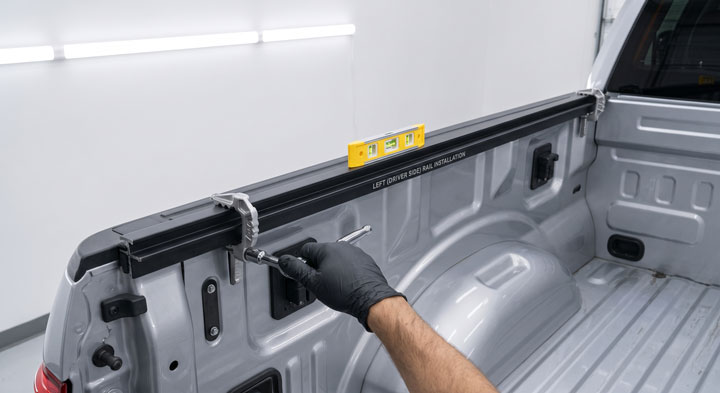
Position the left (driver side) mounting rail along the inside top edge of your F-150 bed cap.
Push the front end of the side rail firmly against the bulkhead weatherseal until it rests completely flush.
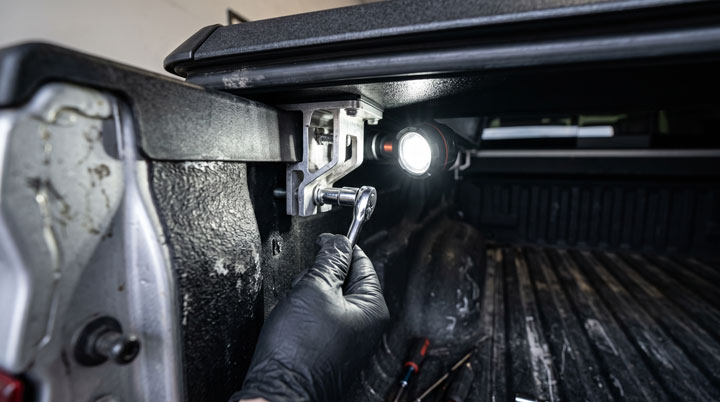
Attach the first bed clamp near the front bulkhead wall, making sure the clamp teeth engage the bed cap lip correctly.
Attach additional clamps in the middle and rear positions, maintaining horizontal alignment with your spirit level before tightening bolts.
Tighten the mounting clamp bolts with a 1/2-inch socket wrench until snug, avoiding excessive torque that could warp aluminum bed rails.
Repeat this exact mounting procedure for the right (passenger side) mounting rail, ensuring equal height on both sides.
Step 4: Mount and Latch the Tonneau Cover Assembly
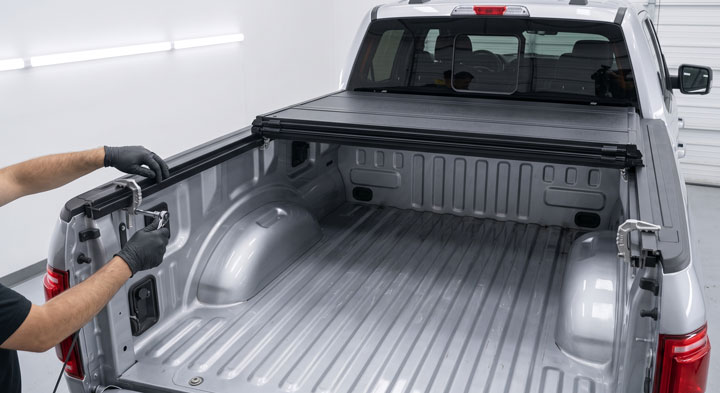
Carefully lift the folded tonneau cover assembly onto the front end of the side rails near the cab bulkhead.
Unfold or roll out the cover toward the tailgate to verify that side locking latches drop into the rail tracks cleanly.
Ensure the cover sits perfectly square between the left and right bed rails across the entire truck bed length.
Secure the front corner retention bolts or quick-release clamps that lock the main cover housing to the side rails.
Step 5: Adjust Tension Control and Latch Engagement
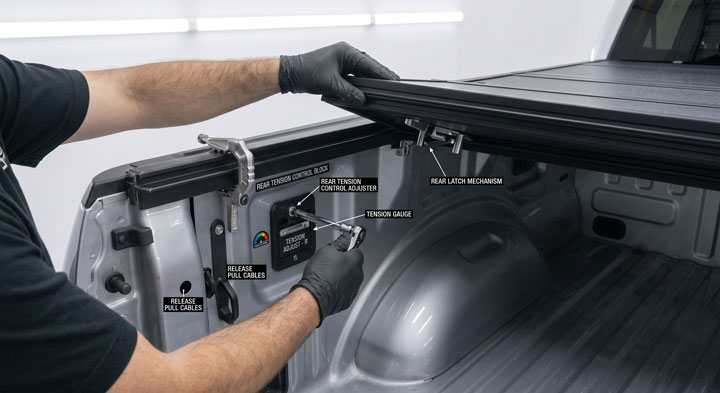
Fold back the cover slightly to access the rear tension control blocks located near the tailgate latch mechanisms.
Adjust the tension adjusters evenly on both sides to achieve uniform vinyl or aluminum panel skin tightness.
Close the tonneau cover firmly until the rear latching pins engage the side rail catch plates with a distinct clicking sound.
Test the release pull cables on both sides to verify smooth, unhindered unlatching operation.
Step 6: Route Drainage Hoses and Complete Tailgate Check
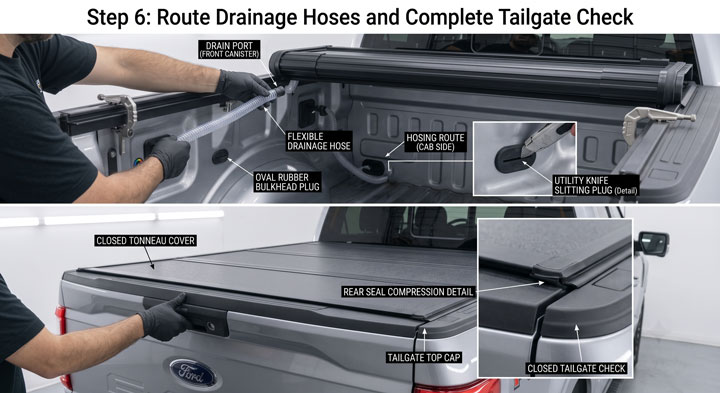
Attach the flexible rubber drainage hoses to the drain ports located under the front rail corners or retractable canister housing.
Route the drain hoses down through the existing oval rubber access plugs located at the front wall of your F-150 truck bed.
Gently remove or slice a small slit in the rubber factory plugs so the drain hoses exit out under the vehicle frame.
Close your F-150 tailgate carefully to verify proper seal compression against the tailgate top cap without binding.
If you encounter alignment challenges or tricky bed liner contours during your install, explore our detailed DIY repair guides at Bryan’s Garage.
Comparing F-150 Tonneau Cover Types: Hard Tri-Fold vs Soft Roll-Up vs Retractable
Choosing the right cover design depends on your daily cargo needs, security requirements, and overall accessory budget.
Each style features unique mechanical mounting mechanisms and weatherproofing characteristics suited for different truck owners.
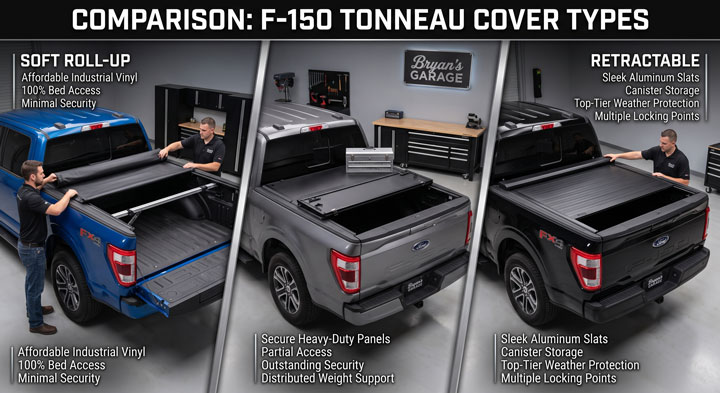
Soft Roll-Up Tonneau Covers
Soft roll-up covers consist of heavy-duty industrial vinyl stretched over crossbar supports and side hook-and-loop fasteners.
They represent the most affordable entry point for Ford F-150 owners looking to keep cargo dry without spending high amounts.
When rolled forward toward the cab, soft covers grant full 100-percent bed access without obstructing rear window visibility.
However, soft vinyl covers offer minimal security against sharp knives or determined theft attempts compared to solid panel designs.
Hard Tri-Fold Tonneau Covers
Hard tri-fold covers feature heavy-duty aluminum or composite fiberglass panels hinged together in three distinct folding sections.
These covers offer outstanding security because locking your F-150 tailgate prevents unauthorized access to interior panel release latches.
Hard-folding panels support distributed weight loads up to 300 pounds, making them ideal for carrying snow or heavy equipment on top.
The primary compromise is that folded panels rest against the rear cab window when fully open, slightly reducing rearward visibility.
Retractable Tonneau Covers
Retractable covers utilize segmented aluminum slats that slide smoothly into a compact storage canister mounted at the front bulkhead.
They offer push-button or smooth manual operation, allowing you to lock the cover at multiple interval points along the bed.
Retractable systems deliver sleek aesthetic appeal and top-tier weather protection across all four seasons.
However, the internal storage canister occupies about 12 inches of upper cargo space directly behind your front bulkhead wall.
| Cover Style | Mechanical Construction & Security | Best For & Price Range |
|---|---|---|
| Soft Roll-Up | Industrial vinyl skin, aluminum frame, hook-and-loop rails. Basic knife protection. | Budget conscious owners needing full bed access. ($200 – $400) |
| Soft Folding | Vinyl covered aluminum frame, quick-latch clamps. Moderate weather seal. | Quick tool-free installation and easy removal. ($250 – $500) |
| Hard Tri-Fold | Aircraft aluminum panels, double-seal channels. High anti-theft security. | All-weather durability and heavy cargo protection. ($600 – $1,200) |
| Hard Quad-Fold | Four rigid aluminum panels, full upright cab storage position. Max clearance. | Hauling tall cargo without removing cover assembly. ($800 – $1,400) |
| Retractable Aluminum | Interlocking aluminum slats, sealed canister, key lock system. Maximum security. | Premium sleek styling and versatile locking positions. ($1,200 – $2,500) |
| Painted Fiberglass One-Piece | Solid color-matched composite shell, gas struts. Complete weather seal. | Show truck styling and maximum weatherproofing. ($1,000 – $2,000) |
| Heavy-Duty Commercial Panel | Diamond plate aluminum, 500lb top load capacity, integrated tie-downs. | Contractors hauling tools and upper deck equipment. ($1,500 – $3,000) |