I still remember standing at the gas pump on a freezing Tuesday morning, staring in disbelief as the total price ticked past sixty dollars for my daily commuter crossover.
That painful weekly routine pushed our team to conduct a comprehensive honda crv fuel economy comparison to discover which model years and engine setups actually protect your hard-earned cash.
At Bryan’s Garage, we analyzed decades of EPA data and real-world owner logs to help you pick the most efficient Honda CR-V for your driveway.
Honda CRV Fuel Economy Comparison Gas vs Hybrid MPG by Year
In This Article
Gas vs Hybrid Powertrain Comparison: Direct head-to-head analysis of city, highway, and combined miles per gallon.
Generational Fuel Economy Breakdown: Complete historical comparison from 1997 First Gen to 2026 Sixth Gen.
Used Model Year Sweet Spot: Identifying which used model years offer maximum fuel economy per dollar spent.
AWD vs FWD Fuel Efficiency Penalties: Calculating the exact fuel consumption trade-offs for all-wheel drive traction.
Mechanical Factors & Maintenance Solutions: Expert diagnostic steps to restore lost MPG on high-mileage vehicles.
🔴 MOST OWNERS NEVER FIND THIS
Your CR-V has a secret trick that starts the SUV when your key fob dies. And 14 other things Honda never told you.
Dead fob fix · Global window down trick · The hidden folding picnic table · Walk Away Auto Lock · and 11 more.
Honda CR-V Gas vs Hybrid MPG: Which Powertrain and Model Year Belongs in Your Driveway?
Selecting the right crossover engine configuration requires balancing your daily driving environment against long-term fuel savings targets.
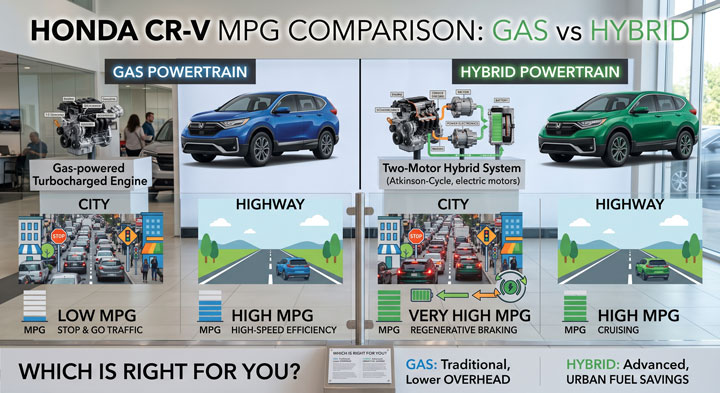
The Honda CR-V offers two distinct engineering approaches: a traditional gas-powered turbocharged engine and an advanced multi-mode two-motor hybrid system.
Evaluating a thorough honda crv gas mileage comparison reveals dramatic performance variations between stop-and-go city traffic and open highway cruising.
Gas-powered models rely on direct-injection turbocharging to maximize high-speed efficiency while maintaining low manufacturing overhead.
Hybrid powertrains utilize an Atkinson-cycle engine paired with electric traction motors to recapture kinetic energy during braking events.
Attribute / Feature
Honda CR-V Gasoline Powertrain
Honda CR-V Hybrid Powertrain
Primary Engine Architecture
1.5L Direct-Injection Turbo 4-Cylinder
2.0L 4-Cylinder Atkinson-Cycle + Electric Motors
Transmission System
Continuously Variable Transmission (CVT)
Electronic Continuously Variable (e-CVT)
EPA City MPG Range (2020–2026)
27 to 28 MPG
40 to 43 MPG
EPA Highway MPG Range (2020–2026)
32 to 34 MPG
34 to 36 MPG
AWD MPG Penalty
1 to 2 MPG Loss Combined
2 to 3 MPG Loss Combined
Optimal Driving Environment
Long Highway Commutes & Constant Speed
Urban Stop-and-Go & Heavy City Traffic
Maintenance Complexity
Standard Turbo Maintenance (Oil Dilution Care)
Braking Regeneration (Extends Brake Pad Life)
Average Used Price Premium
Lower Upfront Purchase Price
$2,000 to $3,500 Higher Initial Market Value
Honda CRV Fuel Economy Comparison Gas vs Hybrid MPG by Year
City vs Highway Fuel Efficiency Dynamics
City driving imposes severe fuel economy penalties on conventional internal combustion engines due to constant idling and acceleration weight loads.
In urban gridlock, a gasoline CR-V engine consumes fuel continuously while sitting idle at traffic lights.
Conversely, the hybrid model shuts off its internal combustion engine during low-speed crawling and coasting.
The hybrid electric motor drives the wheels directly at city speeds, drawing power stored in the lithium-ion battery pack.
Honda CRV Fuel Economy Comparison Gas vs Hybrid MPG by Year
Mechanic Tip: Drivers whose weekly commutes consist of 70% or more city stop-and-go traffic will save over 150 gallons of gasoline annually by selecting a hybrid model over a standard turbo gas trim.
At high highway speeds, the aerodynamic drag increases exponentially, diminishing the electric motor assist advantage.
On open interstate routes, gasoline models achieve impressive economy numbers that approach hybrid ratings within a tight 2 to 3 MPG margin.
Understanding these acoustic and mechanical characteristics helps buyers select between a new honda crv gas trim or a hybrid alternative.
Front-Wheel Drive vs All-Wheel Drive Mileage Penalties
Adding all-wheel drive traction enhances weather safety but introduces mechanical friction drag into the drivetrain system.
Honda’s Real Time AWD system utilizes a rear differential and center transfer unit that adds approximately 120 to 160 pounds of dead curb weight.
Front-wheel drive configurations eliminate mechanical parasite drag from spinning rear driveshafts during summer dry pavement driving.
Analyzing the exact honda crv gas mileage shows FWD models consistently beat AWD variants by 1 to 2 miles per gallon across every model year.
In snowy northern climates, the minor 1.5 MPG penalty for Real Time AWD is easily justified by dramatic improvements in icy road traction.
Maintenance Costs and Real-World Payback Calculations
Purchasing a hybrid model requires an upfront price premium compared to an equivalent gasoline trim level.
Determining the financial break-even point involves calculating your annual driven mileage against prevailing fuel pump prices.
At an average driving distance of 15,000 miles per year and gas priced at $3.50 per gallon, the hybrid saves approximately $450 to $600 per year in fuel costs.
Mechanic Tip: Hybrid models feature regenerative braking, which uses the electric motor to slow the vehicle down. This system reduces friction wear on physical brake pads, often allowing hybrid brake pads to last past 90,000 miles before requiring replacement.
Gasoline turbocharged models require more frequent oil change intervals to prevent high-temperature oil degradation in the turbocharger housing.
Evaluating long-term reliability between a honda crv hybrid vs gas setup shows both designs offer exceptional mechanical durability when serviced on schedule.
Real-World Driver Mileage vs EPA Laboratory Ratings
Official EPA fuel economy ratings are generated inside temperature-controlled laboratories using standardized chassis dynamometer drive cycles.
Real-world driving conditions involve hills, head winds, aggressive acceleration, cargo loads, and severe climate control usage.
Owner reporting databases like Fuelly reveal that gasoline CR-V drivers frequently achieve within 5% of their EPA combined ratings.
Hybrid owners report wider efficiency swings during extreme cold winter conditions when the engine must run continuously to heat the passenger cabin.
Understanding real-world honda crv gas vs hybrid mileage logs helps buyers set realistic expectations for seasonal fuel expenses.
Our research team at Bryan’s Garage recommends factoring in a 10% winter fuel efficiency drop for all hybrid crossovers.
Powertrain Verdict
The gasoline turbocharged CR-V is the optimal financial choice for highway commuters seeking lower upfront purchase costs and simple mechanical layouts.
The CR-V Hybrid is the clear winner for urban commuters, rideshare drivers, and buyers prioritizing silent low-speed operation and reduced carbon emissions.
For more detailed repair tips, maintenance schedules, and car buying guides, check out our full resource center at Bryan’s Garage.
Honda CR-V Fuel Economy History: Generational Breakdown from 1997 to Present
Honda CRV Fuel Economy Comparison Gas vs Hybrid MPG by Year
Examining the complete honda crv fuel economy history illustrates Honda’s continuous mechanical engineering improvements over nearly three decades.
Every generation shift introduced new transmission gear ratios, engine valve timing innovations, and weight-saving high-strength steel chassis designs.
First Generation (1997–2001)
The original First Generation CR-V debuted with a naturally aspirated 2.0-liter 4-cylinder engine (B20A/B20Z) producing 126 to 146 horsepower.
Engineered with a traditional 4-speed automatic or 5-speed manual transmission, this pioneer model prioritized unibody utility over extreme fuel economy.
EPA ratings under modernized testing criteria average 19 MPG city, 23 MPG highway, and 21 MPG combined for AWD automatic models.
Despite modest fuel economy numbers by modern standards, First Gen models established Honda’s reputation for indestructible crossover mechanical components.
Second Generation (2002–2006)
The Second Generation upgraded to the legendary 2.4-liter K24A1 engine featuring i-VTEC intelligent variable valve timing.
Power jumped to 160 horsepower while simultaneously improving thermal efficiency and low-end throttle response.
Transmission choices expanded to a 5-speed automatic in 2005, elevating highway cruising fuel economy.
EPA ratings reached 20 MPG city, 25 MPG highway, and 22 MPG combined for FWD variants.
Reviewing historical honda crv generations highlights how the K24 engine set the benchmark for four-cylinder reliability.
Third Generation (2007–2011)
The Third Generation featured a lower, wider stance with improved aerodynamic drag coefficients to combat highway air resistance.
Powered by an updated 2.4-liter K24Z engine producing up to 180 horsepower, it mated exclusively to a refined 5-speed automatic transmission.
Front-wheel drive models achieved an EPA rating of 20 MPG city, 27 MPG highway, and 23 MPG combined.
All-wheel drive models posted 20 MPG city, 26 MPG highway, and 22 MPG combined.
Fourth Generation (2012–2016)
The Fourth Generation introduced major mechanical transmission breakthroughs that transformed mid-speed fuel economy numbers.
Early 2012–2014 models retained the 5-speed automatic, achieving 23 MPG city and 30 MPG highway in FWD trim.
In 2015, Honda introduced the Earth Dreams 2.4-liter direct-injection engine paired with a Continuously Variable Transmission (CVT).
This major powertrain refresh boosted 2015–2016 FWD fuel economy to an impressive 26 MPG city, 33 MPG highway, and 29 MPG combined.
Fifth Generation (2017–2022)
The Fifth Generation downsized the engine displacement while introducing turbocharging technology across EX trim levels and above.
The 1.5-liter L15B7 turbocharged engine produced 190 horsepower while delivering 28 MPG city, 34 MPG highway, and 30 MPG combined in FWD trim.
In 2020, Honda launched the first US-market CR-V Hybrid, combining a 2.0-liter Atkinson engine with a two-motor electric drive system.
The 2020–2022 CR-V Hybrid came standard with AWD and achieved a staggering 40 MPG city, 35 MPG highway, and 38 MPG combined.
Sixth Generation (2023–Present)
The Sixth Generation refined both powertrain options with stiffer chassis mounting points and updated control software modules.
Standard gas models with the 1.5T engine maintain a solid 28 MPG city, 34 MPG highway, and 30 MPG combined rating in FWD trim.
The updated hybrid system introduced a side-by-side electric motor arrangement with direct high-speed gear locking.
The Sixth Generation CR-V Hybrid FWD achieves an outstanding EPA rating of 43 MPG city, 36 MPG highway, and 40 MPG combined.
Comparing these figures against honda crv competitors shows Honda maintaining top-tier status in compact crossover efficiency.
Which Year CR-V Has the Best MPG? Finding the Used Vehicle Sweet Spot
Honda CRV Fuel Economy Comparison Gas vs Hybrid MPG by Year
Finding which year crv has best mpg requires analyzing both initial purchase budget and long-term fuel expenditure savings.
The Ultimate Used MPG Winner: If maximum absolute fuel economy is your target, the 2023–2026 Sixth Generation CR-V Hybrid FWD takes top honors with an astonishing 43 MPG city and 36 MPG highway rating.
However, for budget-conscious used car shoppers, purchasing a latest-generation hybrid may not fit your immediate financial plan.
Analyzing the entire used crossover market reveals a clear value sweet spot for used car buyers prioritizing efficiency per dollar spent.
The 2015 and 2016 Fourth Generation gas models represent an exceptional used value purchase.
These model years feature the Earth Dreams CVT transmission that elevated highway fuel economy to 33 MPG, yet sell for significantly less than newer Fifth Gen turbos.
The 2017 to 2019 Fifth Generation gas models offer another outstanding used sweet spot.
They provide the modern 1.5-liter turbocharged engine achieving 34 MPG highway while dodging the higher price tags of brand-new showroom inventory.
Shopping for a certified used honda crv from these specific model years allows you to achieve modern fuel efficiency while skipping steep initial depreciation costs.
Mechanical Factors That Degrade CR-V Fuel Economy and How to Fix Them
Honda CRV Fuel Economy Comparison Gas vs Hybrid MPG by Year
Even a fuel-efficient Honda engine suffers severe MPG losses if underlying mechanical components deteriorate over time.
At Bryan’s Garage, our master mechanics routinely diagnose high-mileage crossovers suffering from a sudden 3 to 6 MPG economy drop.
Dirty Air Filters: A clogged engine air filter restricts airflow into the intake manifold, forcing the engine control unit (ECU) to adjust fuel trim ratios inefficiently.
Fouled Spark Plugs: Modern iridium spark plugs last 100,000 miles, but tip wear creates incomplete combustion cycles that waste unburnt fuel through the exhaust.
Mechanic Warning: Direct-injection engines on 2015+ models are prone to carbon buildup on intake valves. Excessive carbon restricts cylinder air velocity, causing rough idling, engine hesitation, and noticeable fuel economy degradation.
Sticking Brake Calipers: A dragging brake pad creates constant mechanical resistance, forcing the engine to burn extra fuel simply to maintain cruising speeds.
Oxygen & MAP Sensor Degradation: Aging upstream O2 sensors report inaccurate air-fuel ratios to the ECU, causing the engine to run excessively rich.
Low Tire Inflation Pressure: Under-inflated tires increase rolling resistance, wasting up to 3% of your fuel tank capacity for every 5 PSI drop below placard specs.
Continuously Variable Transmissions (CVTs) rely on clean, un-degraded fluid to maintain belt tension and prevent internal slippage.
Drain and refill CVT fluid every 30,000 to 45,000 miles using genuine Honda HCF-2 transmission fluid.
Fresh transmission fluid reduces internal hydraulic drag, ensuring smooth ratio transitions and optimal cruising engine RPMs.
Step 4: Adopt Econ Mode and Smooth Throttle Modulations
Engage the dashboard Econ button to smooth out aggressive accelerator pedal inputs and optimize automatic climate control compressor cycles.
Anticipate traffic lights ahead by easing off the throttle early, allowing the vehicle to coast rather than braking abruptly at the last second.
On hybrid models, utilize steering wheel regenerative braking paddles to maximize energy capture when descending hills.
Common Fuel Economy DIY Pitfalls and Maintenance Oversights
Executing DIY vehicle maintenance is a rewarding way to save money, but simple oversights can compromise engine performance.
Using incorrect engine oil viscosity is one of the most frequent DIY mistakes made by crossover owners.
Modern Honda engines require ultra-low viscosity oils such as 0W-20 or 0W-16 to reduce internal crankshaft windage resistance.
Filling the crankcase with heavier 10W-30 oil increases oil pump drag, reducing fuel economy by 1 to 2 MPG while stressing variable valve timing actuators.
Another common mistake is ignoring small vacuum hose leaks or loose intake duct clamps after replacing an air filter.
Unmetered air entering the engine bypasses the Mass Air Flow (MAF) sensor, confusing the engine management computer.
This triggers rich fuel trims that burn excessive gas while illuminating the check engine light on your instrument cluster.
Always verify intake clamps are tight and vacuum lines are fully seated before closing your hood.
🟢 Going viral on CR-V Owners Club & Reddit
“I’ve driven a CR-V for 4 years and didn’t know this existed.” — The most common reaction when this article is shared
15
features
1997+
models
15 min
read
Free
no signup
Did you know your backup camera has a hidden top-down ‘drone view’? Or that your cruise control automatically downshifts on steep mountain hills to save your brakes?
Frequently Asked Questions About Honda CR-V Fuel Economy
Is the Honda CR-V Hybrid worth the extra purchase price over the gas model?
Yes, for drivers who log over 12,000 miles annually with a heavy concentration of city driving, the hybrid model repays its price premium within 3 to 4 years.
In addition to fuel savings, hybrid owners enjoy smoother low-speed acceleration, quieter cabin operation, and extended brake pad lifespan.
Why is my CR-V getting much lower MPG than the EPA rating on the window sticker?
Lower real-world MPG is usually caused by aggressive driving speeds over 70 MPH, short trips in freezing weather, under-inflated tires, or dragging brakes.
Roof rack crossbars, cargo boxes, and heavy aftermarket wheels also create severe aerodynamic drag and weight penalties that degrade highway fuel economy.
Does using the air conditioner lower CR-V miles per gallon?
Yes, operating the AC compressor draws mechanical horsepower from the engine, reducing fuel economy by approximately 1 to 3 MPG in hot weather.
At low city speeds, open windows create less drag than running the AC; however, at highway speeds above 55 MPH, closed windows with AC engaged is more aerodynamic and efficient.
How does cold winter weather affect CR-V Hybrid gas mileage?
Cold weather reduces battery chemical efficiency and forces the gas engine to run continuously to supply heat to the cabin interior heater core.
Hybrid owners typically experience a 10% to 18% drop in fuel economy during severe winter months compared to ideal summer driving temperatures.
Which generation of used Honda CR-V offers the best overall fuel economy value?
The 2015–2016 Fourth Generation (with Earth Dreams CVT) and the 2017–2019 Fifth Generation (with 1.5L Turbo) offer the best used fuel economy value.
They achieve 33 to 34 MPG highway while avoiding the higher purchase prices associated with newer showroom models.
Conclusion
Analyzing a comprehensive honda crv fuel economy comparison empowers you to choose the exact model year and engine setup that fits your budget.
Whether you choose a highway-efficient turbo gas model or an ultra-thrifty city hybrid, proactive maintenance ensures peak fuel efficiency for years.
Ready to transform your car maintenance from a stressful chore into a breeze? Explore more tips at Bryan’s Garage.
Have questions? Our team can help you find the best solutions for your car problems and avoid costly mechanic visits.
Note: Individual results may vary depending on individual vehicle makes, models, year of manufacture, and overall condition. This article is intended for general automotive reference purposes only and does not replace official manufacturer service manuals or advice from a certified mechanic.