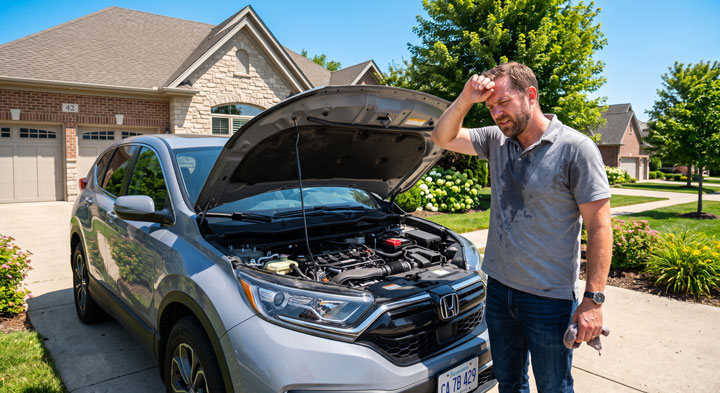
I still remember standing in my driveway on a blistering hot July afternoon, sweating through my shirt while staring under the hood of a vehicle suffering from a sudden honda crv ac condenser leak.
Watching warm air blast from the dashboard vents while an icy breeze should be flowing is a deeply frustrating experience every vehicle owner dreads.
At Bryan’s Garage, we have helped thousands of drivers navigate tricky cooling system failures, extended dealership warranties, and hands-on repairs so you can get cold air blowing again without burning a hole through your hard-earned savings.
Honda CRV AC Condenser Leak Symptoms Warranty and Replacement
In This Article
Comprehensive Troubleshooting: How to identify distinct visual signs, oily residues, and sound cues of a leaking air conditioning condenser.
Warranty Navigation: Understanding Honda’s 10-year extended coverage policies, eligible model years, and how to avoid rejected claims.
Step-by-Step DIY Replacement: A detailed mechanic checklist for safely removing, replacing, and recharging your CR-V’s condenser at home.
Cost & System Protection: Calculating true repair expenses and protecting your air conditioning compressor from catastrophic oil starvation.
🔴 MOST OWNERS NEVER FIND THIS
Your CR-V has a secret trick that starts the SUV when your key fob dies. And 14 other things Honda never told you.
Dead fob fix · Global window down trick · The hidden folding picnic table · Walk Away Auto Lock · and 11 more.
How to Diagnose, Fix, and Claim Warranty for a Honda CR-V AC Condenser Leak: A Master Mechanic’s Guide
Diagnosing and repairing an air conditioning failure on a modern crossover requires an understanding of both modern refrigerant systems and manufacturer bulletin coverages.
Before jumping straight into tools and replacement steps, you must equip yourself with the proper inspection equipment and safety gear.
Replacing an air conditioning condenser involves handling pressurized gas, delicate aluminum fins, and precise chemical charges.
You will need a basic metric socket set, body clip removal tools, a UV leak detection flashlight with yellow safety glasses, a manifold gauge set, a vacuum pump, and high-purity replacement refrigerant gas.
If you suspect electrical issues along with cooling failure, reading your honda crv check engine codes using a standard scanner can confirm if pressure switches are triggering system lockouts.
Follow our comprehensive step-by-step workflow below to tackle your condenser issues safely and efficiently.
Step 1: Perform a Visual Inspection and UV Dye Leak Test
Honda CRV AC Condenser Leak Symptoms Warranty and Replacement
Start your inspection by looking directly through the front lower bumper grille where the condenser sits right ahead of the radiator core.
Look carefully for wet spots, dark dirt accumulation, or a distinct honda crv green oil leak front residue clinging to the thin aluminum cooling fins.
Factory air conditioning oil contains yellow-green fluorescent dye that glows brilliantly under an ultraviolet light source.
Shine your UV flashlight across the entire face of the condenser, paying special attention to corner welds and tube joints.
If you spot bright green luminescent streaks, you have confirmed an active refrigerant leak path on your vehicle.
Make sure to distinguish between top surface insect splatters and actual oily chemical stains coming from within the core tubes.
Step 2: Check Your Honda Extended Warranty and TSB Eligibility
Do not order replacement parts immediately after locating a pinhole leak until you check your vehicle’s factory coverage status.
Honda issued special technical service bulletins extending condenser coverage to 10 years with unlimited mileage for specific model ranges.
You should review official details regarding the honda crv ac condenser warranty extension to determine if your specific VIN qualifies for zero-cost dealership repair.
Keep in mind that dealers will verify if the leak stems from a microscopic manufacturing tube defect rather than external stone impact damage.
If a stone or road debris punctured your condenser tube face, the manufacturer warranty will not cover the repair bill.
If your model falls outside extended policy parameters, check your registration document against honda crv ac condenser warranty recall years guidelines before paying out of pocket.
Step 3: Safely Recover Refrigerant and Disassemble the Front Bumper
Prior to loosening any refrigeration line fittings, you must take your vehicle to a certified facility to recover existing gas pressure legally.
Ventening chemical refrigerant directly into the atmosphere violates environmental protection guidelines and creates safety hazards.
Once the cooling loop is completely depressurized, pop open the hood and disconnect the negative 12-volt battery terminal.
Use your trim tool to remove the plastic push rivets securing the top engine radiator cover panel.
Remove the lower engine splash shield fasteners along with bolts hidden inside each front wheel arch liner.
Gently pull the outer edges of the front bumper fascia away from the quarter panels until the entire plastic assembly disengages.
Honda CRV AC Condenser Leak Symptoms Warranty and Replacement
Step 4: Swap Out the Leaking Condenser Unit and Replace Seals
With the front core support fully exposed, disconnect the ambient air temperature sensor and move wiring harnesses out of the way.
Unbolt the aluminum high-pressure and low-pressure refrigerant lines attached to the side of the leaking condenser assembly.
Cap the open aluminum line ends immediately using clean shop plugs to prevent moisture and dirt contamination from entering the system.
Unscrew the top mounting bracket bolts holding the upper condenser rubber cushions in place.
Lift the damaged condenser straight upward out of its lower mounting slots while keeping it clear of the delicate radiator fins behind it.
Always install brand-new HNBR rubber O-rings coated in fresh PAG oil onto the line fittings before bolting down your new replacement condenser unit.
Step 5: Evacuate the Air Conditioning Loop and Recharge with Refrigerant
Connect your manifold gauge set hoses to the vehicle service ports, linking the center charging hose to a dedicated vacuum pump.
Turn on the pump and open both high and low gauge valves to pull the entire closed system down to 29.9 inches of mercury vacuum.
Maintain the deep vacuum for at least 45 minutes to boil off ambient moisture trapped inside the internal aluminum pipe walls.
Close both gauge valves, shut off the vacuum pump, and watch the pressure needle for 30 minutes to verify total vacuum hold tightness.
If the gauge holds vacuum without dropping, charge the system with the exact weight of factory refrigerant specified on your under-hood label.
If you prefer to skip complex line evacuation procedures or want to explore reliable replacement components for your daily driver, check out our complete breakdown of tested automotive parts and maintenance solutions at Bryan’s Garage.
Deciphering the Honda CR-V AC Condenser Failure Mechanics
Honda CRV AC Condenser Leak Symptoms Warranty and Replacement
Understanding the exact physical mechanisms behind a failing cooling component empowers you to make smarter maintenance decisions.
The air conditioning condenser acts as a high-efficiency heat exchanger mounted directly at the front of your vehicle’s engine bay.
Its primary function involves receiving superheated, high-pressure gaseous refrigerant directly from the engine-driven compressor pump.
As ram air passes through the thin aluminum cooling fins during driving, heat transfers out of the gas into the outside atmosphere.
This cooling effect condenses the high-pressure gas back into a liquid state before it travels inward toward the cabin evaporator valve.
In modern crossover models, manufacturing tolerances for aluminum tube walls are kept extremely thin to maximize heat transfer efficiency and lower overall curb weight.
When searching through overall honda crv specs, you will discover that lightweight aluminum alloys are utilized across the entire front cooling module assembly.
However, microscopic manufacturing flaws or chemical corrosion from road salt can cause pinhole microscopic fractures along internal tube seams.
When a microscopic leak opens, high operating pressure forces synthetic PAG lubrication oil out alongside escaping gas molecules.
This chemical displacement frequently creates a visible sticky oil film that attracts fine road dust directly onto the outer grille mesh.
Driven under high heat conditions, low system pressure causes the cooling cycle to collapse, blowing warm ambient air out of your dashboard vents.
Furthermore, running an air conditioning system with low gas levels starves the main rotary compressor of vital circulating oil lubrication.
To prevent internal metal wear, integrated low-pressure cut-off switches disengage the compressor clutch automatically when fluid pressure drops below safe thresholds.
Navigating Honda Extended Warranty, Bulletins, and Recall Coverage Guidelines
Navigating dealership service desks for air conditioning repairs requires clear knowledge of manufacturer technical service communications.
Many drivers confuse technical service bulletins and extended warranty advisories with safety recalls issued by transportation agencies.
Because a non-functioning air conditioner does not pose a direct driving safety hazard, formal government safety recalls are rarely issued for condenser leaks.
Instead, Honda introduced extended warranty coverage programs to assist owners affected by early condenser tube pitting failures.
This special coverage extends standard bumper-to-bumper protection on the condenser part up to 10 years from the original vehicle in-service date with unlimited mileage limits.
However, vehicle owners must understand the precise limitations enforced by authorized dealership service managers during diagnostic checks.
Dealership technicians perform a mandatory dye test and pressure check to confirm the exact origin point of escaping refrigerant gas.
If the leak originates from a microscopic manufacturing corrosion pinhole, the full repair—including labor, parts, and refrigerant recharge—is covered under warranty.
If the technician discovers a foreign object impact mark, such as a sharp pebble puncture or highway stone ding, coverage will be denied outright.
In addition to condenser problems, late-model crossovers sometimes experience compressor shaft seal seepage under high ambient thermal stress.
It is vital to check updates regarding the honda crv ac compressor recall and warranty extension notices to avoid paying for auxiliary seal replacements.
If a dealer confirms your condenser damage resulted from external impacts, you will be responsible for standard retail diagnostic and repair fees.
Understanding these coverage rules helps you avoid unexpected bills when bringing your vehicle into a local service department.
Step-by-Step Diagnostic Workflow for Air Conditioning Leak Detection
Systematic diagnostic procedures eliminate guesswork and prevent you from throwing expensive replacement parts at simple problems.
Honda CRV AC Condenser Leak Symptoms Warranty and Replacement
Follow this master mechanic diagnostic routine to isolate leaks quickly and accurately in your garage.
Step 1: Check System Pressure with Gauges: Hook up a digital or analog manifold gauge set to both service ports while the engine is turned off. If both high and low needles rest at zero pressure, your system has lost its entire chemical charge through a major leak point.
Step 2: Inspect the Front Condenser Face: Remove top radiator shroud clips and shine a UV flashlight downwards between the radiator and bumper core. Look specifically for fluorescent yellow-green glowing trails near lower seam welds and pipe junctions.
Step 3: Listen for Abnormal Mechanical Sounds: Start the engine and turn the temperature control to maximum cold cooling. Listen for an erratic honda crv ac compressor noise or rapid clicking sounds caused by low pressure cycling switches.
Step 4: Verify Compressor Clutch Operation: Observe the front accessory belt pulley while the air conditioner button is activated inside the cabin. If you notice a honda crv ac compressor clutch stuck situation where the hub fails to spin, low system pressure has likely locked out electrical power to protect internal bearings.
Step 5: Perform an Electronic Sniffer Test: Pass a handheld electronic halogen leak detector along the condenser fins, discharge hoses, and evaporator drain line. The sensor will sound a rapid audible alarm when it detects escaping refrigerant vapor molecules.
Comparison of Repair Options: Dealership vs. Independent Shop vs. DIY Fix
Honda CRV AC Condenser Leak Symptoms Warranty and Replacement
Evaluating potential repair pathways allows you to balance your personal budget against available mechanical tools and spare time.
The total ac condenser replacement cost honda crv varies significantly based on where and how the service work is performed.
Review the comparison table below to determine which repair strategy fits your immediate financial and mechanical requirements.
Repair Pathway
Estimated Cost Range
Estimated Time
Key Advantages & Trade-Offs
Dealer Warranty Claim
$0 (If Qualified)
1 to 2 Days
Free OEM parts and labor under extended bulletin; strict inspection rules may reject stone impact claims.
Independent Auto Repair Shop
$650 – $1,100
3 to 5 Hours
Professional vacuum equipment and quick service turnarounds; higher labor charges for bumper fascia removal.
DIY Home Mechanic Replacement
$180 – $350
4 to 6 Hours
Maximum money savings on labor costs; requires specialized vacuum pump, manifold gauges, and safe gas recovery.
Deciding to repair your own cooling system saves substantial labor costs while ensuring your vehicle receives high-quality assembly care.
However, if your vehicle is covered under the 10-year factory advisory extension, taking advantage of free dealership repair remains your best starting option.
If you purchase a secondary market crossover, investigating a used honda crv ac condenser leak history during pre-purchase inspections can save you hundreds of dollars down the road.
Always double-check line fittings and installation torque specs to ensure your new replacement unit delivers years of trouble-free cooling performance.
Overcoming Risks, Safety Hazards, and Common Repair Mistakes
Honda CRV AC Condenser Leak Symptoms Warranty and Replacement
Working with high-pressure automotive refrigeration loops presents distinct physical safety hazards and potential mechanical pitfalls.
Never disconnect pressurized aluminum lines without confirming that total system pressure has been safely evacuated by professional equipment.
Liquid refrigerant expands rapidly upon atmospheric contact, causing instant skin frostbite and severe eye injury if handled recklessly.
Always wear safety goggles, heavy nitrile gloves, and long sleeves when working near open service access valves.
A common beginner mistake involves reusing old rubber O-ring seals during a new condenser installation process.
Old rubber seals harden over time under engine heat cycles, leading to persistent slow leaks even after installing a brand-new aluminum condenser.
When a severe condenser leak starves the cooling loop of oil, internal metallic pistons can generate fine metal debris.
Flushing overall cooling lines thoroughly before installing fresh parts prevents abrasive metal shavings from destroying your new replacement condenser core.
Finally, avoid overcharging the system with off-the-shelf retail cans containing leak-stop sealants.
Chemical stop-leak additives harden upon contact with internal moisture, clogging delicate expansion valve orifices and destroying recovery equipment pumps.
🟢 Going viral on CR-V Owners Club & Reddit
“I’ve driven a CR-V for 4 years and didn’t know this existed.” — The most common reaction when this article is shared
15
features
1997+
models
15 min
read
Free
no signup
Did you know your backup camera has a hidden top-down ‘drone view’? Or that your cruise control automatically downshifts on steep mountain hills to save your brakes?
How can I tell if my Honda CR-V AC condenser leak is covered under warranty?
Coverage depends on vehicle age, total mileage, and the physical cause of the leak confirmed by a dealer technician.
Honda extended warranty coverage to 10 years with unlimited miles for specific 2016 through 2021 models suffering from manufacturing tube defects.
If an inspection proves the leak resulted from internal metal pitting rather than external stone impacts, the repair is 100% free.
Contact your local dealership service department with your 17-digit VIN to confirm exact bulletin eligibility before scheduling an appointment.
What are the primary symptoms of a leaking AC condenser?
The most obvious sign is dashboard vents blowing warm or hot air while the climate control setting is turned to maximum cold.
You may also observe an oily green film on the lower front grille mesh or hear continuous clicking sounds from the engine bay.
This clicking noise occurs when internal pressure switches repeatedly engage and disengage the compressor clutch due to low gas levels.
In severe cases, complete pressure loss prevents the air conditioning system from turning on entirely.
Is it safe to drive my car with a leaking AC condenser?
Driving your vehicle with a damaged condenser will not damage your primary engine mechanicals or compromise basic road safety.
However, running the air conditioning system while refrigerant is low can cause severe oil starvation inside the compressor pump.
To prevent costly secondary compressor damage, press the cabin AC button to turn the system completely off until repairs are finished.
This prevents the belt clutch from engaging and running internal pump pistons without adequate lubrication oil.
How much does it cost to replace a Honda CR-V AC condenser at an auto shop?
Having a professional independent auto repair shop replace your condenser typically costs between $650 and $1,100 total.
Parts prices for an aftermarket or OEM aluminum core generally range from $180 to $380 depending on brand selection.
Labor charges make up the remaining balance, requiring 3 to 5 hours of work to disassemble front bumper trim and perform system evacuations.
Dealership retail costs without warranty coverage can exceed $1,200 due to higher OEM component pricing and specialized hourly labor rates.
Can I replace the AC condenser on my Honda CR-V at home?
Yes, skilled DIY home mechanics can replace a condenser using standard hand tools, body clip pliers, and safety equipment.
However, you must have an EPA-certified shop recover your old refrigerant gas legally before opening sealed aluminum line connections.
After installing the fresh condenser and new O-rings, you must use a vacuum pump to evacuate air and moisture prior to recharging.
Skipping proper vacuum evacuation will result in poor cooling performance and rapid corrosion inside your freshly repaired refrigeration system.
Conclusion
Fixing a leaking condenser restores your cabin comfort and protects your entire cooling system from expensive secondary compressor damage.
Whether claiming factory extended warranty coverage or tackling a hands-on weekend DIY repair, verifying leak points with UV dye remains the ultimate key to success.
Ready to transform your car maintenance from a stressful chore into a breeze? Explore more tips at Bryan’s Garage. Have questions? Our team can help you find the best solutions for your car problems and avoid costly mechanic visits.
Note: Individual results may vary depending on individual vehicle makes, models, year of manufacture, and overall condition. This article is intended for general automotive reference purposes only and does not replace official manufacturer service manuals or advice from a certified mechanic.“`